

Zeitgeist Stage's Director David Miller and Playwright Jacques Lamarre Take on Staging a Play about Mass Shootings from the Perspective of the Family's Shooter in "Trigger Warning"
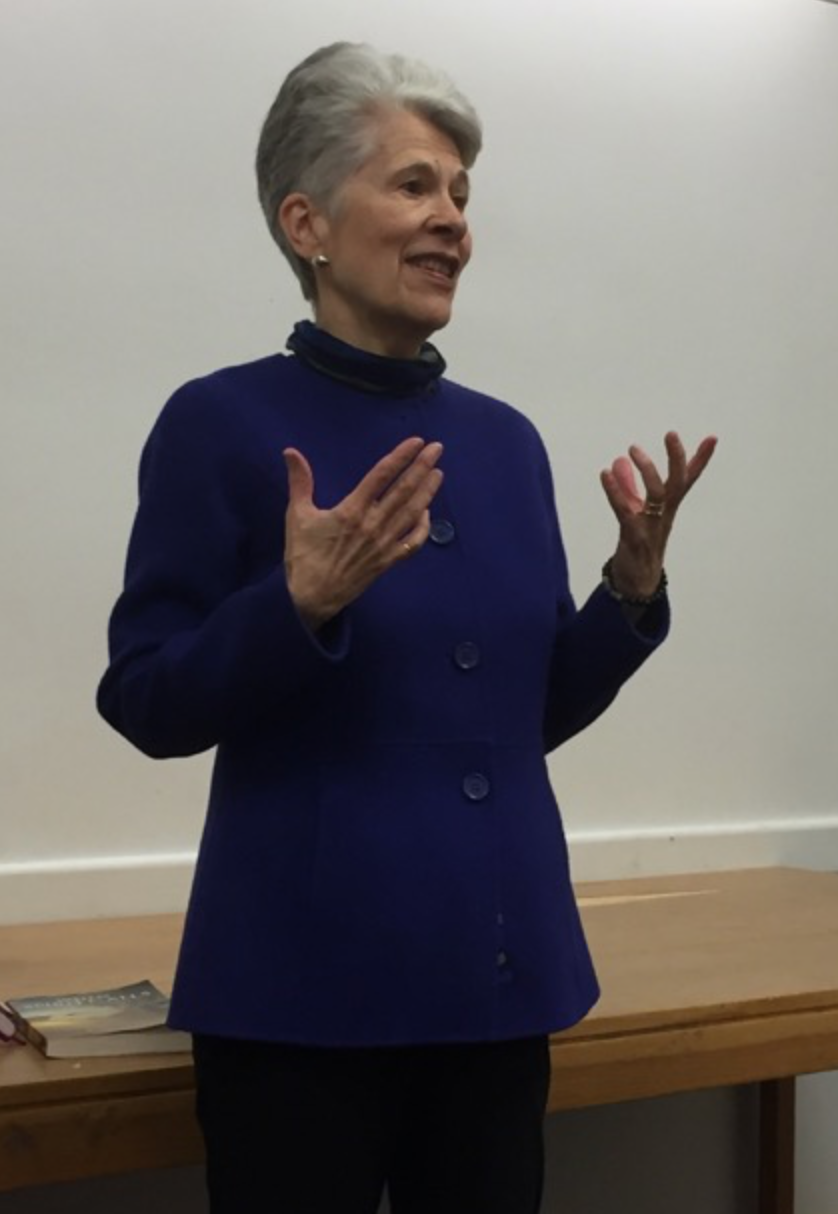
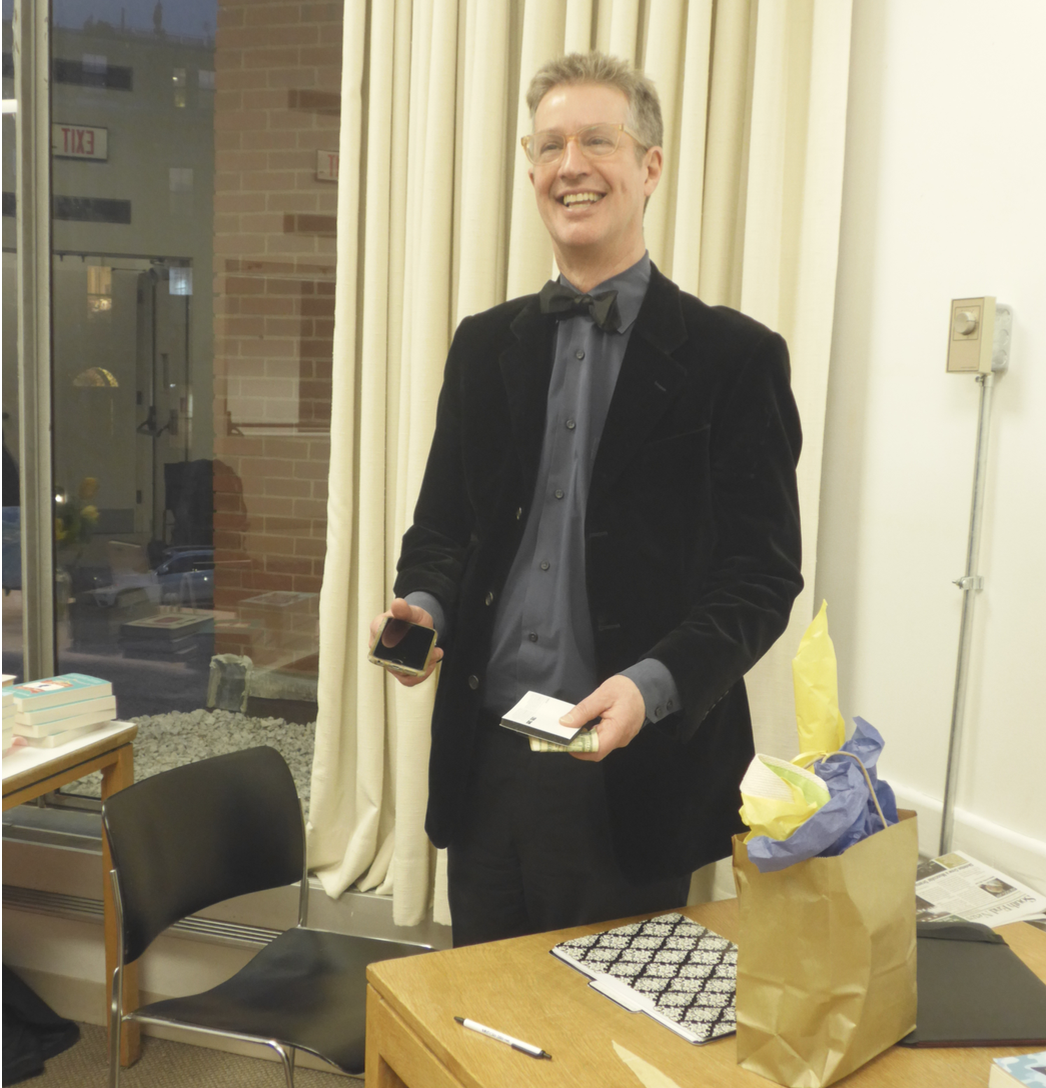
How does a play go from the pages of a script to a full-blown performance on stage? Last February 26, award-winning director of the Zeitgeist Stage Company, David Miller, took a stab at answering that question. Seated in a semi-circle with Miller and playwright Jacques Lamarre, three actors cast in his play, Trigger Warning, read through scenes that took a look at how a mass shooting impacts one family, that of the shooter. Two of the actors were part of earlier Zeitgeist plays: Steve Auger in Vicuna; Kelley Estes in Far Away, Hiding Behind Comets, Cakewalk, and Tigers Be Still. For Liz Adams Trigger Warning will be her first Zeitgeist show.

Trigger Warning’s genesis was a Boston Foundation announcement that it wanted to award grants to the Boston theatre community for new work, explained Miller, who contacted playwright Lamarre to commission the play. Lamarre had just finished reading the memoir A Mother’s Reckoning by Suzanne Klebold, mother of Columbine’s High School mass shooter, Dylan Klebold. Lamarre asked Klebold if he could adapt her memoir. She declined. Zeitgeist did not get a grant from the Boston Foundation, either. But the play, Trigger Warning, will open on April 12 at the Boston Center for the Arts.
Lamarre lives in Hartford, CT, the town where Colt Manufacturing Company created the town’s gilded age by producing weapons for the Civil War and later, as Lamarre commented wryly, guns for the country itself, including mass shootings. He lives minutes from the site of the Hartford Distributors shooting where nine people were killed in 2010; Newington, where five Connecticut Lottery employees were murdered in 1998; and one hour from Newtown, CT, the site of the Sandy School Elementary School shooting of 20 students and six teachers by Adam Lanza, who also killed his mother earlier that same day at the home they shared.

To demonstrate a play’s evolution, the three actors read from two scenes, the first followed by a discussion with the library audience about the main subject of the play, the role of guns in the American family and its consequences. In the scene, the parents of the shooter, Travis, who has fatally shot a number of people, injured his 16-year-old sister and killed himself, are alone for the first time at the home where the shooting took place. The father, a contractor, is a gun owner whose guns, though locked away, had been used by his son for the mass shooting. The injured daughter had left her parents’ house to live with her aunt. The parents bantered back-and-forth in a manner that at some level felt surprisingly normal, the way any couple will go back and forth, but with comments and questions that alluded to the devastating turn their lives had taken and to their having entered the unknown territory of being shunned by their community, the fictional town of Plainville.

“What’s going to happen to us,” they asked each other, and “I lost two clients today” and “should we sell the house?” and “did you love Travis?” and the answer: “Yes, but I wish he’d never been born.” Playwright Lamarre talked about the killers’ families, the other victims of shootings who generally are not acknowledged even though their lives, too, have been destroyed by the shooter. They become families at war with themselves: What could they have done differently? The mother of Dylan Klebold, for example, went from a well-respected member of the community to someone who had to go into hiding to mourn the loss of her son who had killed the children of families in that same community. At some point, she had to acknowledge her son had become “a monster.” Likewise, the mother of Adam Lanza, Sandy Hook’s mass shooter, had lived in fear of her son. But the fictional parents of Travis in Trigger Warning had known something was wrong, and had taken Travis from therapist to therapist, without finding something that helped their son. No one had an answer.
Director Miller, whose plays were nominated last month for nine Small-Stage awards by the Independent Reviewers of New England (IRNE), told the audience that Zeitgeist Stage always produced plays that reflect “the spirit of the times,” so mass shootings was a relevant subject. There had been numerous documentaries, and plays, but never from the perspective of the shooter, he said. The initial title, Thoughts and Prayers, as in the usual comments offered, was determined to be too passive. Trigger Warning is both a general warning for events that may trigger trauma but, in this case, the word “trigger” has a more appropriate duality, he said.
After the cast held a read-through of the play’s first draft in December, followed by an in-depth discussion with Lamarre, the playwright returned two weeks later with a revised draft. “It evolved organically,” he said. “You never see the shooter. He had added several characters who each represented another aspect of the story: A minister, who asked the shooter’s mother not to come to church anymore to avoid upsetting the other parishioners; and a lawyer, to fend off the lawsuits by enraged parents. The Klebolds were bankrupted by their son’s ass shooting at Columbine, as was their insurance company. Scenes evolved further with the mother talking to the minister and the father to the lawyer, each describing from different points of view being cast out from the community they were a part of. The daughter, living with the mother’s sister, moreover, attends a “Never Again” rally in town, multiplying the arguments for a law suit against the parents.

Lamarre said he wanted to capture the depth of the rejection by the community of the parents of the shooter: How can you go on when no one is on your side and there is no spiritual comfort or legal protection, and relentless media coverage turning the violence into entertainment? He noted that in Columbine, fourteen trees were planted to memorialize all the students killed, including the shooters, but those trees were cut down.
Director Miller said Zeitgeist Stage had once before staged a play about a school shooting, called Punk Rock. It was 2015 and the company was in rehearsal for it when the Marathon Bombings occurred. When the play went on stage, three weeks later, there were numerous discussions about mass shootings after the performance. “People felt they wanted and needed to talk about it,” Miller said.
At the library’s Page to Stage discussion, several audience members brought up a 1,000-page book by Andrew Solomon, titled Far From the Tree. Miller and Lamarre had read it as part of the preparation for Trigger Warning as it deals with so-called expectations violation, when parents find themselves in a situation through their children that is not the norm. “No parent wants to be seen as a failure,” Lamarre said, but what do parents do when they experience expectation violation, whether through their children’s mental health issues, dwarfism, or mass shootings?
Trigger Warning will be performed at the Boston Center for the Arts from April 12 through May 4 and will be the last play of the last season of Zeitgeist Stage Company which has announced it will close. The staff and the cast will leave a big hole in the South End theatre community. Lamarre’s next play is an adaptation of Wally Lamb's holiday novella., called Within’ & Hopin.’

Joan Diver, a Subject of J. Anthony Lukas's "Common Ground," and Author of "When Spirit Calls: A Healing Odyssey," Found a Spiritual Common Ground as Faith Healer

January 15 was an auspicious day for claiming to be “on common ground.” It was the day of a reading by a distinguished former South End resident, Joan Diver, who returned to her former neighborhood’s library to read from her debut memoir, When Spirit Calls: A Healing Odyssey. The Divers were one of the three families profiled in the award-winning book by J. Anthony Lukas about the South End’s struggle with school integration and forced busing, titled Common Ground. January 15 would have been Dr. Martin Luther King, Jr.’s 90th birthday and, as Rev. Tim Crellin of St. Stephens Church who introduced the author pointed out, also claimed “common ground,” for humanity regardless of the color of their skin.

Rev. Tim Crellin of St. Stephen’s Church introducing Joan Diver.
Father Crellin captured the anticipation in the room where Joan Diver explained her quest for a spiritual life after devastating pain from an injured back forced her to seek relief in non-traditional venues and methods in cultural settings of both East and West. “Some of you may be joining us this evening because you know Joan from her days living just around the corner from where we are right now,” Rev. Crellin said, “or from her nearly two decades leading the Hyams Foundation, or from her leadership on boards like the Associated Grant Makers, the United Way and countless others. Perhaps you came because you know at least part of her story from reading Tony Lukas’ now classic book. Or maybe you came out tonight because you’ve heard about Joan’s commitment to healing: physical, emotional, spiritual. Regardless of why you’re joining us tonight, you’re in for a treat.”
Joan Diver answering questions from an engaged audience about her spiritual voyage
Diver, who with her husband Colin, had hoped to raise their two boys in the South End in the 1970s but was thwarted by the constant battle over street crime and school choice, said she will always be connected to the South End. Moving to Newton to access better schools for their sons was traumatic. They grieved over it and felt guilty for not staying to face the challenges of raising a family in the South End. When Lukas sought them out to profile their experience for the book he was writing about busing, she was very reluctant at first but then relented. “Tony told our story, which was a healing experience for us,” adding, “I could never have written my story of healing without the Boston story.”

Longtime South End resident Ann Hershfang reconnecting with Colin Diver, who became Dean of the U. Penn. Law School after leaving the South End, and subsequently served as President of Reed College (OR)
She fondly remembers the rich diversity of the South End, and requested a few moments of silence. “I want to talk about why I left a job I loved to write my healing story,” she said. “It was both an adventure and a love story and a tale of discovery of universal love that connects us and is the ultimate common ground. The adventure took me from West Newton Street to Newton Corners, from convicts hanging out on our street corner to watching people led to their execution in China, from an operating room at Beth Israel to a healing room in Santa Fe. These were never planned events but ones that called on me.”
Her medical crisis led her to surgery, after which she experienced certain phenomena, like a blinding white light that came and went, and a growing psychic awareness of “some challenges that come from dimensions that we’re not familiar with,” as well as a growing sense of the existence of “a universal consciousness.” A friend, a psychic, suggested this was part of a re-balancing of physical, mental and psychological energy. Diver became convinced that turbulent times, in a personal and a broader sense, represented “a great breaking open,” something that is “coming up for its healing, like a boil.”

On various trips she took after her surgery she became familiar with members of healing communities with whom she was able to communicate in a spiritual understanding. She experienced a “crossing of boundaries” into previous lives she may have lived, including ones where she had been raped and committed suicide. “I felt love and forgiveness after that,” she said, “like I had become a different person, one with more confidence.” Lurching from painful medical crises to recovery and back again several times, Diver traveled a parallel path of the mind that led her to want to train as a healer, hoping to help others who were in psychic and physical pain. She participated in healing initiations that took her to Egypt, India, China and Mount Sinai. She became convinced that we were “all led in some way, in our mind or by something beyond our minds,” but kept wondering, “what was driving me?”
Diver began to connect a new-found spirituality to certain decisions she had made, including of a medical procedure that she had suspected she did not need but left her in pain for nine months. She focused on whether there are “multiple messages” to help determine what one should do but concluded that “you need to open up to it.”

Southenders standing in line to buy a copy of Joan Diver’s book and having her sign it…
Members of the audience asked her to expound on this, pointing out that some people may see signs that lead to good places and others to bad ones. “How do you know the difference?” they asked. Diver answered that “everyone has their own path but if each of us, and enough of us, open our hearts a whole population can shift. It’s a shift of consciousness.”
Diver described how a certain incident had caused her family to leave the South End: Husband Colin had hit a burglar with a baseball bat, and became terrified he would hurt someone even worse in the future. “But now you see it as a call,” someone asked her.
“Whether we are led or called, we all have these signals,” she said. “Some see it, others don’t.”

Foreign Affairs Journalist, Stephen Kinzer, Believes Ayanna Pressley and Her Freshman Colleagues Need to Try and Change U.S. Defense Priorities to Pay for the Domestic Programs They Champion

Stephen Kinzer, a former bureau chief for the New York Times in the Middle East and current world affairs columnist for the Boston Globe, addressed a large audience at the South End library in December by saying he was “very impressed” with the new crop of Congressional representatives elected in 2018. A longtime critic of America’s interventionist foreign-policy, Kinzer’s talk focused on what would be a sensible US relationship with Iran and Syria. The concern he expressed, however, was that the new representatives are “too focused” on domestic issues and not enough on foreign policy. Taking as an example Ayanna Presley, the new congresswoman from the South End who defeated Michael Capuano, Kinzer said she “has not said a word” about the outside world.
“She defeated someone who did,” Kinzer added. “Her goals are domestic ones, free Medicare and so on. But the enormous outlays required for defense will be used to deny her the funding for the domestic programs she would like to see. We have to work on Ayanna Pressley to make sure she understands the linkage between domestic and foreign policies. Our job is to keep asking questions.” As a “refreshing example” of a new approach to world affairs Kinzer referred to Rashida Tlaib (D. -Michigan), the first Palestinian-American woman elected to Congress, who is not going to take the traditional freshman trip to Israel sponsored by AIPAC but instead hopes to take a trip to Palestine and highlight the Israeli occupation of the Palestinian territories and provide an alternate perspective.

Kinzer was introduced by the widely admired radio host of WBUR’s Open Source, Christopher Lydon, who also reported for the New York Times, before he started The Connection on WBUR in the 1990s. Lydon said that during the 2016 presidential campaign both he and Kinzer thought Hillary Clinton’s approach to foreign policy was “a problem” and that Trump at that time seemed to be sending a different signal, among other things, by calling the Iraq invasion, and Hillary’s support for it, ‘catastrophic.’ “He doesn’t seem so bad,” Lydon recalled they thought.
“But now,” he asked, “should we repent?”
The background for the invasion of Iraq, which Kinzer and Lydon agreed was the worst policy decision by any American president ever, was the Carter Doctrine. Laid out in the 1970s by National Security Advisor, Zbigniew Brzezinski, it proclaimed that the US would use military force, if necessary, to defend its national interests in the Persian Gulf. The 1978 revolution in Iran, which overthrew the US-backed Shah, and the 1979 hostage crisis is what set the stage for a hostile relationship with Iran, as far as the US is concerned. But says Kinzer, for the Iranians, it began much earlier, in 1953, when the US overthrew their democratically elected government of Prime Minister Mohammad Mossadegh and installed the Shah of Iran.

Now, for the US, Iran is a red flag. “ They are considered the demons in the world. If a country is a friend of Iran, the US can lay waste to them,” said Kinzer. “The US is so deeply involved in Yemen because the Saudi and US justification is that there’s a group in Yemen that likes Iran.” Similarly, he said, negotiations sponsored by the United Nations under Kofi Annan and the Arab League to end the Syrian war early on didn’t proceed because Secretary Clinton would not sit down with Assad. There was little recognition that Iran supports Syria for fear that if it doesn’t, ISIS will take over Syria, remove Assad, kill his (Alawite) supporters, and Iran will next have a Sunni state on its border. “For Iran, there are two existential threats,” Kinzer explained. “Their environmental problems related to lack of water and droughts is one, and the Jihadists under ISIS is the other. This is why Iran would not allow for the destruction of Syria and Assad. We’re now six years into the Syrian war which might have been avoided.”
Kinzer’s position is that we should align ourselves with those countries whose goals are similar to ours. “Why are we in the Middle East at all, we should ask ourselves. Iranian society looks so much more like ours than Saudi society. We have similar goals: They hate ISIS and Al Queda even more than we do.” He suggested we need to “reassess our misunderstanding about Iran after two generations of misguided obsession.”
Having taught journalism, political science, and international relations at Northwestern University and Boston University, Kinzer appreciates news sources that offer a broad and varied perspective on news. They include TomDispatch (for anyone seeking a deeper understanding of our post-9/11 world and a clear sense of how our imperial globe actually works); Lobelog (A Different Perspective on Foreign Policy): and Consortium News (An Investigative Journalism and Political Review Since 1995). “The lack of agility in American foreign policy is remarkable,” he commented. “The world has changed but our foreign policy goals have not. Iran is a big country in the middle of the Middle East: We can’t ignore it.” He acknowledged that there are terrible dictatorships in the Middle East but the US has not been able to make better countries out of any of them by being concerned about human rights.
In 2006 Kinzer published Overthrow: America's Century of Regime Change from Hawaii to Iraq which describes the 14 times the United States has overthrown foreign governments, why these interventions were carried out and what their long-term effects have been. He has made several trips to Iran, and is the author of All the Shah's Men: An American Coup and the Roots of Middle East Terror. Word has it, this book was part of John Kerry's library when he was Secretary of State under the Obama administration. It described, among other events, how the CIA overthrew Iran's elected government in 1953.

Kinzer, a South End resident, said that Congress appears to be waking up from its “Iran coma” and show the beginnings of a rebellion against our involvement in the Saudi war with Yemen, as a result of the Saudi murder of journalist Jamal Khashoggi. But, he warned, the US arms industry is very powerful and has Congress in its grip. “Not just the individual members of Congress are in their corner with contributions, but when Lockheed Martin and other defense contractors get a large contract, it is subbed out to many districts in the US and provides jobs,” Kinzer pointed out. “Cutting back on defense means loss of jobs and politically difficult decisions for politicians.”
Answering a question from the audience about how to make things better, Kinzer circled back to the newly elected members of Congress, including Ayanna Pressley. “We need to make sure that she will advance on her victory and articulate the foreign policy goals that she would pursue that would not be a waste of money. We have to build on their success by encouraging them to do so.”
Kinzer is a Senior Fellow at the Watson Institute for International and Public Affairs at Brown University, where he teaches International and Public Affairs. “I love my students,” he said. He is currently working on a ne book that will be out in October. It is called, Poisoner in Chief: Sidney Gottlieb, MK-ULTRA, and the CIA Search for Mind Control, about the American chemist and spymaster who was involved in the CIA's assassination and mind control program, known as Project MKULTRA, in the 1950s and 1960s. Kinzer promised he would be back at the South End library to talk about it. Stay tuned…
A

Delicious Platters of Food, Fabulous Jazz Music by the Pat Loomis Band & Trombonist Jeff Galindo, and a Crowd of Library Supporters Made the South End Library Holiday Party the Best Ever

FOSEL board members, library staff and volunteers dishing out delicious dinners for all

Saxophonist Pat Loomis and Special Guest Jeff Galindo on trombone
Each year, the South End library’s holiday party gets bigger and better: time for a bigger library to accommodate it all. On December 18, a crowd of more than sixty people stood in line for a holiday dinner featuring platters of delicious food prepared by the chefs at the South End Food Emporium on Columbus Avenue, generously donated as their holiday gift to the South End library. In addition, library supporters, Friends of the Library’s board members and library staff brought cheese platters, scrumptious appetizers, (non-alcoholic) mulled wine, jambalaya, hot chocolate with all the trimmings and an outstanding selection of cakes and desserts.

Antonio Loomis, Pat Loomis and Colescott Rubin weaving great music into the holiday party’s cheer
That was only the beginning: Pat Loomis and his fabulous Band of Friends managed to book a star performer, top trombonist Jeff Galindo, who graduated from Berklee College of Music, and has played with the greats, including Chick Corea, Ray Charles, Aretha Franklin, the Artie Shaw Orchestra, the Village Vanguard Orchestra and the Boston Pops, among others. The Loomis band included Pat Loomis, alto and soprano sax; Antonio Loomis, guitar; Jim Dower, piano; Colescott Rubin, bass; and Benny Benson, drums. The music they played together was fantastic.
The concert between-the-book-stacks featured O Tannebaum, Jingle Bells, the Christmas Song, Winter Wonderland, Silver Bells, Christmas Time is Here and Santa Claus is Coming to Town. By eight o’clock, all the food had been consumed and the libations had been drunk, except for what had been put aside for the musicians by vigilant food servers who ant them to return next year...

Retired library staffer Deborah Madrey returned to see her friends and supporters

Young and old enthralled by the musical performance

Hot chocolate with all the trimmings for the children provided by library staff

Joan Wickersham, Prize-winning Author of "The Suicide Index" and "The News from Spain," Says "Bungling" When Writing is What Writing Is About for Her

Joan Wickersham first visited the South End library in May of this year when she introduced Pulitzer Prize-winning writer Megan Marshall who presented her acclaimed biography of the poet Emily Dickenson. Wickersham, herself an award-winning author and op-ed writer for the Boston Globe, also covers architecture and was immediately taken by the Michell-Giurgola design of the South End branch. “I am so pleased to be back in this beautiful library,” she said when she returned on November 30 to talk about her own work. “And I love the idea of writers speaking in libraries. It is the ‘backstage’ part of the book.”
The author of a short-story collection, The News from Spain (2012), and a memoir, The Suicide Index: Putting My Father’s Death in Order (2008), was introduced by novelist Sue Miller. She described the arc of Wickersham’s work as “going from strength to strength.”

But Wickersham would not linger on the glory: “I want to talk about the bungling that happens,” she said. “There’s a lot of bungling in writing books. When I bungle, I feel lost and stupid. But that is what writing is for me: I have to be wrong before I get it right.” To illustrate, she described how long it took to write about her father’s suicide, first as a novel, which took eight years and, as she put it, “wasn’t very good,” and then by reducing the novel’s 400-some pages to about 70. “It felt liberating,” she recalled. The process to publication of the memoir took eleven years.

She rewrote what remained not as a ‘genre’ but as an ‘index’ with fragmentary pieces and bits of stories about the suicide, in first-, second- and third-person narratives. Some of it was dark; some of it funny, but the process was deeply personal and took a long time. “Suicide interferes with memory,” she commented, “and that always had to be factored in.” When her mother died of natural causes, she knew the person who she was missing. “But missing my father had a mystery,” she explained. “The suicide was a major piece of information that interfered with my memory of him. So while I can remember writing about a good day we had, perhaps it was not a good day for him.” Some agents she showed the manuscript to loved the material and the voice, but not the organization. “The reader needs a safe place to stand,” she was told, which is how she came up with the idea of the Index.

The Suicide Index was chosen as one of the year's best books by the Washington Post, the Boston Globe, the Los Angeles Times, the Cleveland Plain Dealer and New York Magazine, among others. It was an ALA Notable Book. It won the Salon Book Award, the Ken Book Awards of the National Alliance on Mental Illness, and was a finalist for the National Book Awards.
The News from Spain, begun during a MacDowell Fellowship, was an easier project. She wrote three of the stories in six weeks. A collection of 17 short stories, each with the same title, Wickershim said they described thwarted love stories about feelings no one wanted to talk about. “In a sense both my books presented formal structures for messy materials, like a corset,” she commented. She read selections from a few, one about a middle-aged couple about to get engaged but not feeling any passion, yet, not wanting to be alone. The collection was named one of the year's best books by Kirkus Reviews, the San Francisco Chronicle, and NPR. Two of the stories were chosen for The Best American Short Stories and The Best American Nonrequired Reading.
The author has received the Ploughshares Cohen Award for Best Short Story and has been awarded grants by the National Endowment for the Arts, The Massachusetts Cultural Council, the MacDowell Colony, and Yaddo. She has taught at Harvard, Emerson, the University of Massachusetts (Boston), and the Bennington Writing Seminars.
Wickersham is currently working on a book based on the true story of a warship built in the 17th century on the order of the King of Sweden. It was deemed unsinkable. But its bronze cannons and other extravagant features made the ship so top heavy that it sank in Stockholm harbor within minutes of encountering a breeze on its maiden voyage. Wickersham might call that a bungle, too.

Melinda Lopez, prize-winning actress and Playwright, Who Insists Plays Must Have "Heart and Compassion," Will Present Her Adaptation of Federico Garcia Lorca's "Yerma" in June at the Huntington

Prize-winning actress and playwright Melinda Lopez came to the South End library in October, on what she joked was the first “Red-Sox-free night,” to talk about her remarkable career in the theatre. She was introduced by Isabel Alvarez Borland, Distinguished Professor of Arts and Humanities at the College of the Holy Cross in Worcester, MA, who called Lopez “one of the most exciting playwrights in the US.” They met through work at Holy Cross where Lopez was a speaker at Borland’s Transcending Borders seminar. “She still skypes with my students,” Borland noted.
Lopez grew up bi-lingual and launched her career by reading new plays at the Playwrights Center in Minneapolis, MN. From there, she moved to staged performances, including Romeo and Juliet at the Portland Stage Company in Portland, ME (1997); and A Month in the Country (2002); The Rose Tattoo (2004) and Persephone (2007) at the Huntington. Attuned to dialogue, Lopez wondered if she might do more than interpret the stories of others if she had her own compelling stories to tell?
Lopez began to write plays “to see what I had to say,” and discovered she had a lot to say. “Theatre is meant to keep a community together, like a church, where you are with your people,” she said. She writes plays with big themes, centered on Latino/Cuban women. because, as she put it, she likes to see them on stage as she sees them, flawed, complex, powerful. Although she discovered through her writing that she is “deeply political” she said she doesn’t write “political” plays. “They are plays with complicated, messy, talented women at their center,” she said. “My evil plan is, I think I can make you feel you like them.” Lopez was accepted into the MFA Playwrighting Program at Boston University where Nobel Prize-winning poet and author, Derek Walcott, was her mentor. In 2013, Lopez was named the first Playwright-in-Residence at the Huntington Theatre, thanks to a grant from the Andrew W. Mellon Foundation.

Her 2004 play at the Huntington, Sonia Flew, was awarded both the IRNE and Eliot Norton Awards for Best New Play that year. Sonia Flew has since been produced by the Steppenwolf Theatre in Chicago, the San Jose (CA) Repertory Theatre and other theater companies. Lopez's other plays include Alexandros (2008); Caroline in Jersey (2009); and Becoming Cuba ( 2014.). Her poignant and powerful one-character play Mala, the only one of her works in which she also appears, won the 2016 Eliot Norton Award for Best New Play. Based in part on cellphone notes taken while caring for her mother at the end of her life, Lopez wanted to remember that time, though it was difficult and overwhelming. “All plays ask intensely personal questions,” Lopez reflected, “and Mala is the most personal.” She started to create the play just before her mother died. “I was trying to be a good daughter,” Lopez said. “I did not always succeed.”
Lopez read sections from an adaptation she is working on of the 1934 play Yerma, part of a rural trilogy by Federico Garcia Lorca, who was assassinated by Spanish fascists in 1936. Written in the last five years of his life to include Blood Wedding and The House of Bernarda Alba, Lopez felt the translations from the Spanish were written by academics, not by dramatists for actors who speak it. A play has to have “heart and compassion” and must “celebrate the human condition, whether it is for the author, a cast member or, as with Yerma, the translator and adaptor,” she said. The play, an adaptation with music, songs and flamingo guitars, will open in June, 2019, at The Huntington.
The dialogue Lopez presented was between two friends in the countryside, Yerma, a young woman who longs for a child but can’t have one, and her best friend, Maria, who keeps having babies. All Yerma wants is an ordinary life. It becomes her obsession. Maria tells Yerma, “but you have other things, quiet mornings. I am fed up with having them. Every day there’s more desire and less time.” Lopez feels that theater is at its best when exploring the existential questions of life and living. “We believe that if we work hard, we can achieve what we want,” Lopez says. “What if our fate and desire are in conflict? Where does desire go if it can’t be fulfilled?”
Lopez is also working on a podcast serial in collaboration with Audible, of which she has completed four episodes. The story centers on a “Big Oil” lawyer, Tony, who defends an 80-year-old man over a marijuana-related offense, someone with whom he shares a secret dating from the time of the 1980 Mariel boat lift when the Cuban government released many prisoners who then sought asylum to the United States.
.

Jessica Keener, Author of “Strangers in Budapest,” Literary Explorer of the Human Psyche and Mysteries of Life, Believes "We're All Survivors of Silence"

It was a rainy November night when prize-winning author Jessica Keener came to the South End library to read from her second novel, Strangers in Budapest, but some two dozen people braved the weather to hear all about it, anyway. The novel tells the story of a young American family in the early 1990s pursuing a post-Communist-era business opportunity in the architecturally glittering city on the Danube.
Annie in her thirties and husband Will are from Boston and just adopted a baby. Annie is fleeing her painful past and hoping to create a better future for her family, but encounters a city with inhabitants that are scarred by their own difficult history, dominated by Communism and the Nazi occupation. Annie and Will are asked to check up on the tenant of neighbors in the US, Edward, who is working through the wrongful death of his daughter and trying to figure out how far revenge should take him. He digs at Annie’s secrets: In trying to help others, is she trying to help herself?

Author Jessica Keener (left) with Lynne Potts, poet and South End history scribe
Boston Magazine called Strangers in Budapest “a perfect page-turner for late autumn" and the Library Journal said it was a “slow burn of an international psychological thriller.” The novel was chosen for Best New Books for November by the Chicago Review of Books and was selected as an INDIE NEXT pick for December 2017. Keener told an intent audience she was interested in “plopping Americans in a different culture and see what happens” and, more generally, in the expectations of individuals and how these interact with the norms of society. “There was a tango between the locals and the Americans where the Americans think all is possible and the Hungarians think everything is impossible,” Keener said.
Keener, who grew up in Newtonville, MA, spent a year in Budapest herself. She didn’t know the language, which felt “shocking” to her and made her feel she was “the other.” While soaking up the city’s culture, she could not escape how the gorgeous architecture of the buildings was marred by bullet holes and the ravages of war. “There’s a mystery in Budapest’s presence,” Keener reflected. “It’s a magical city in certain ways, somewhat like Boston, very walkable and with a river running through it. There are even streetcars. But the violent marking are so present. The war seemed still so close.”

At-large City Councilor, Annissa Essaibi-George, a strong library and education supporter, introduced Jessica Keener to the South End library audience
Themes of death and violence run through Keener’s work, in part forced by her own experience as a teenager faced with a life-threatening blood disease. Keener’s short-story collection, Women in Bed, includes Recovery, a tale based on her illness, which she survived thanks to an experimental bone-marrow transplant in the 1970s. The story won Redbook Magazine's second prize in fiction. But even before that happened, Keener had become familiar with her father’s memories of helping to liberate the concentration camp, Dachau, a powerful experience he couldn’t articulate, she said, because he couldn’t understand how that could happen. “He would cry talking about it,” she recalled. “It influenced me as a Jew. And as a Jew going back to Europe I had to think about oppression a lot,” she added.

In response to a question from the audience about the menace and brooding quality of the novel, its sense of lurking danger, as well as the high, poetry-like quality of her prose, Keener answered she had to face death “for a good long time.” Poetry is an exploration of the mystery of life, she elaborated. Keener said she could not relate to reviewers’ descriptions of her novel as a thriller, either. “I see myself more as a psychological writer of suspense,” she commented, “someone who explores the urgency of the characters’ needs, the outer layer of their extreme emotions, the rage and grief that comes with facing death. I am interested in the human psyche, in the mystery of life. We’re all survivors of silence.”
Keener’s debut novel, Night Swim, was a widely praised national bestseller. Her fiction has been critically reviewed by the New York Times, the Boston Globe, Booklist, The Jewish Book Council, and Publisher's Weekly, among many others. She has taught creative writing and wrote many feature articles for the Boston Globe Magazine, Opra Magazine, Design New England and Poets and Writers, among other publications. She is a recipient of a Massachusetts Cultural Council Grant in Fiction.
Keener was introduced by one of Boston’s At-large city councilors, Annissa Essaibi-George, who said she loves to read and wished she had more time for it. Essaibi-George, the parent of four sons and a strong education and library advocate on the City Council, added she hopes her sons will become great readers, too.

Odyssey Opera Backer, Randolph Fuller, Delivers Another Passionate Talk at the South End Library about his Favorite Subject: Great Opera in Boston
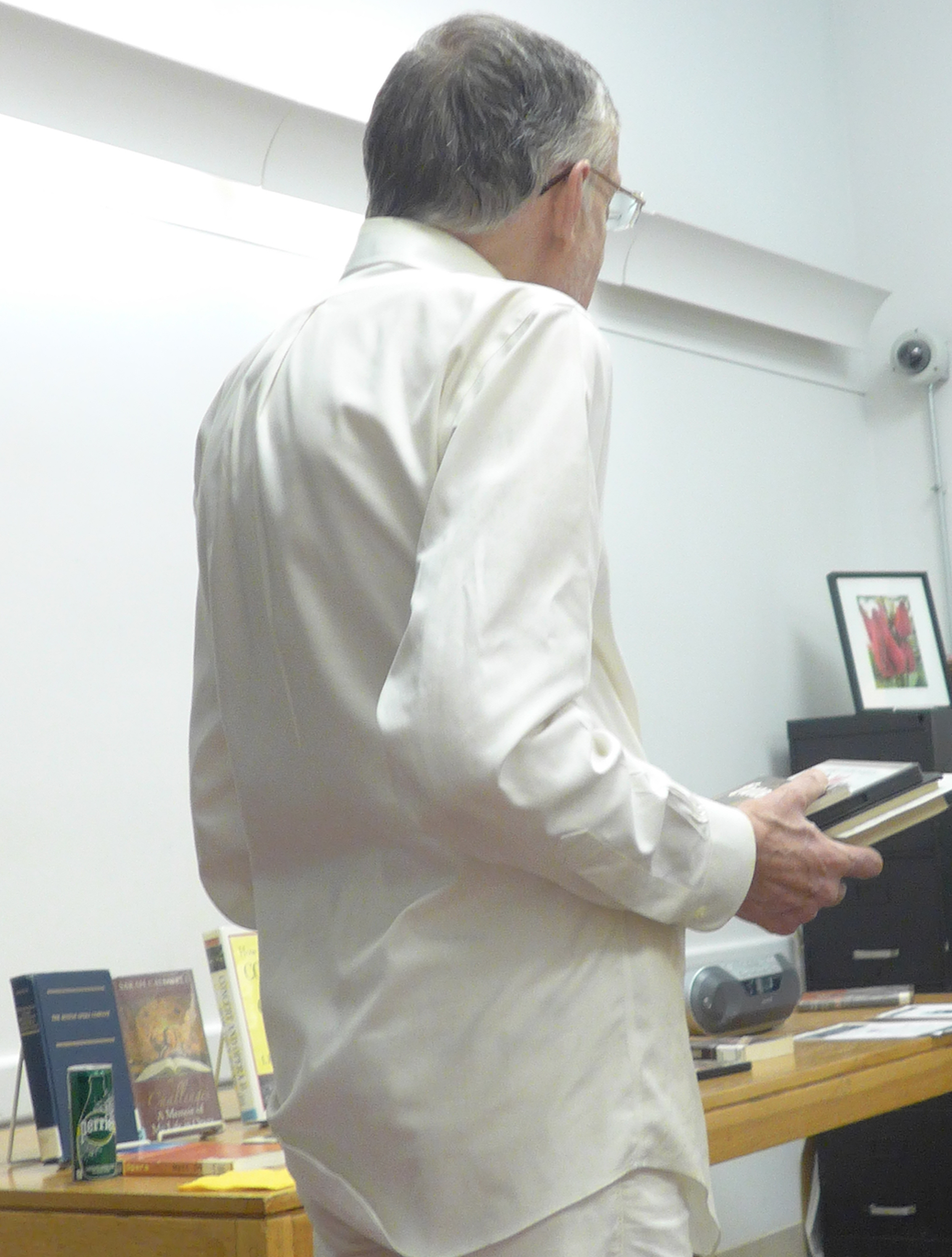
Randolph Fuller, Odyssey Opera founder (with composer/musical director Gil Rose), ready to treat the audience to a talk about his favorite subject
South End resident Randolph Fuller, whose unflinching enthusiasm for opera in Boston was on full display in an October 9 talk, described the mission of the Odyssey Opera company he founded with conductor Gil Rose as “staging important but unheard masterpieces by famous composers,” or by others who are not so well known. ”There’s no Grand Opera’ House here In Boston,” said Fuller, a longtime financial backer of local opera, “so you can’t hear them live other than at Odyssey.” Fuller graciously replaced Gil Rose, who had been scheduled to speak, but was unable to due to an unexpected scheduling conflict.

19th-century French composer Charles Gounod
Rose and Fuller began the Odyssey Opera series in 2013, the 200th anniversary of Richard Wagner’s birth, with his opera Rienzi, inspired by the tale of rebellion by a 14th-century army officer against the nobility. Rose and Fuller like to have a theme for the season, such as was the case in 2016-17’s Wilde Opera Nights, when three of the five operas that season touched on the life and work of Oscar Wilde: Lowell Liebermann’s semi-staged The Picture of Doran Gray; Mario Castelnuovo-Tedesco’s sung The Importance of Being Earnest; and the Arthur Sullivan/W.S. Gilbert fully staged Patience; or Bunthorne’s Bride. Last year’s season, Trial by Fire, focused its five operas on the life and trials of Joan of Arc.
This year, Odyssey Opera features two works by Charles Gounod in what they call the Goun-Odyssey, on the composer’s 200th anniversary of his birth. For the well-reviewed October performance of The Queen of Sheba, months of detective work was required by Fuller and Rose to get the original score, including a search of the archives Library of Congress. “The last piece was found in a trunk in Italy,” Fuller reported.

An illustration of the final scene of Charles Gounod’s Faust, with the Devil, Faust and Gretchen (or Marguerite).
Gounod, who Fuller described as the greatest French composer of the 19th century, produced twelve operas, including what was perhaps the most popular ever written, Faust, the subject of Fuller’s library talk. “The Faust legend had been irresistible since the late Middle Ages and was reflected in all aspects of art,” Fuller said, including literature and the visual arts. However, the greatest impact of the Faust legend was in music and opera, as in the Franz Liszt symphony, Faust; Wagner’s Faust Overture; Robert Schumann’s Scenes from Faust, and in the operas of, among others, Hector Berlioz The Damnation of Faust and Gounod’s Faust. At the library, Fuller played the Gounod orchestral prelude of Faust for the audience, pointing out the unresolved harmonies and not-quite-clear melodies at the beginning of the piece, resolving themselves into Gounod’s most famous melody at the end when sung by the trio representing Faust, the Devil and Gretchen.
On November 9 and 11, Gounod’s comedic opera will be staged at the Huntington Theatre, based on Moliere’s The Doctor in Spite of Himself.

Sewing for Success for Teens and Tweens on Six "Sewing Fridays" from 3:30 PM to 4:30 PM. Call to Register.
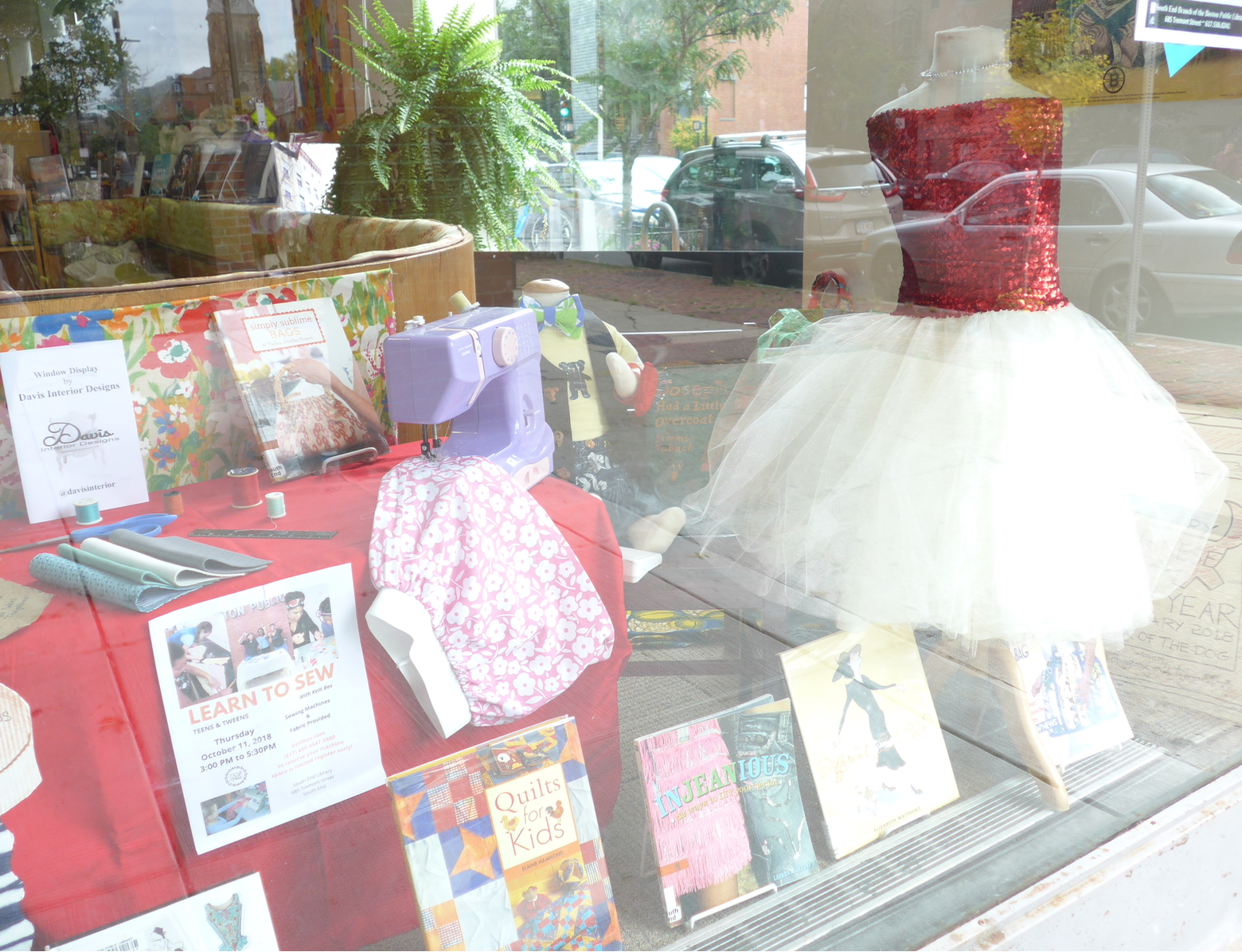
So your teens and tweens don’t know how to sew? The South End branch will offer six one-hour “sewing Fridays” in October and November for teens and tweens. Kelli Bos (Sewing for Success) has installed a lovely display about sewing in the library’s park-side window, featuring a sewing machine, many books about sewing, fabrics, samples of finished pieces and various props.
The first session will be on October 12, followed by instruction hours on October 19 and 26 and November 2, 9 and 16. All dates are on Fridays, from 3:30 to 4:30 PM. Fabrics and sewing materials will be provided. For further information or registration, contact Anne Smart or Margaret Gardner at the South End branch at 617 536-8241. Or call Kelli Bos at 617 455 4547, extension 800, or #sheiskellibos.

The Acclaimed Author of "The Widow of Wall Street," Randy Susan Meyers, Says her Little Branch Library in Brooklyn, NY, Is the First Place Where She Lied...

Randy Susan Meyers, known for her novels of domestic drama (Accidents of Marriage; The Murderer’s Daughter; The Comfort of Lies), told the audience at the South End library in late September that she was “raised by a library” and “worshipped at its altar.” It was an old, shabby public-library branch in Brooklyn, NY, “as small as my hand,” she recalled. But that’s where she discovered Betty Smith’s 1943 coming-of-age novel about Francie Nolan, A Tree Grows in Brooklyn. “I must have read it 10 or 20 times,” she said. Herself the daughter of a single mother with a challenging history of domestic violence, Meyers felt she was not alone any more.
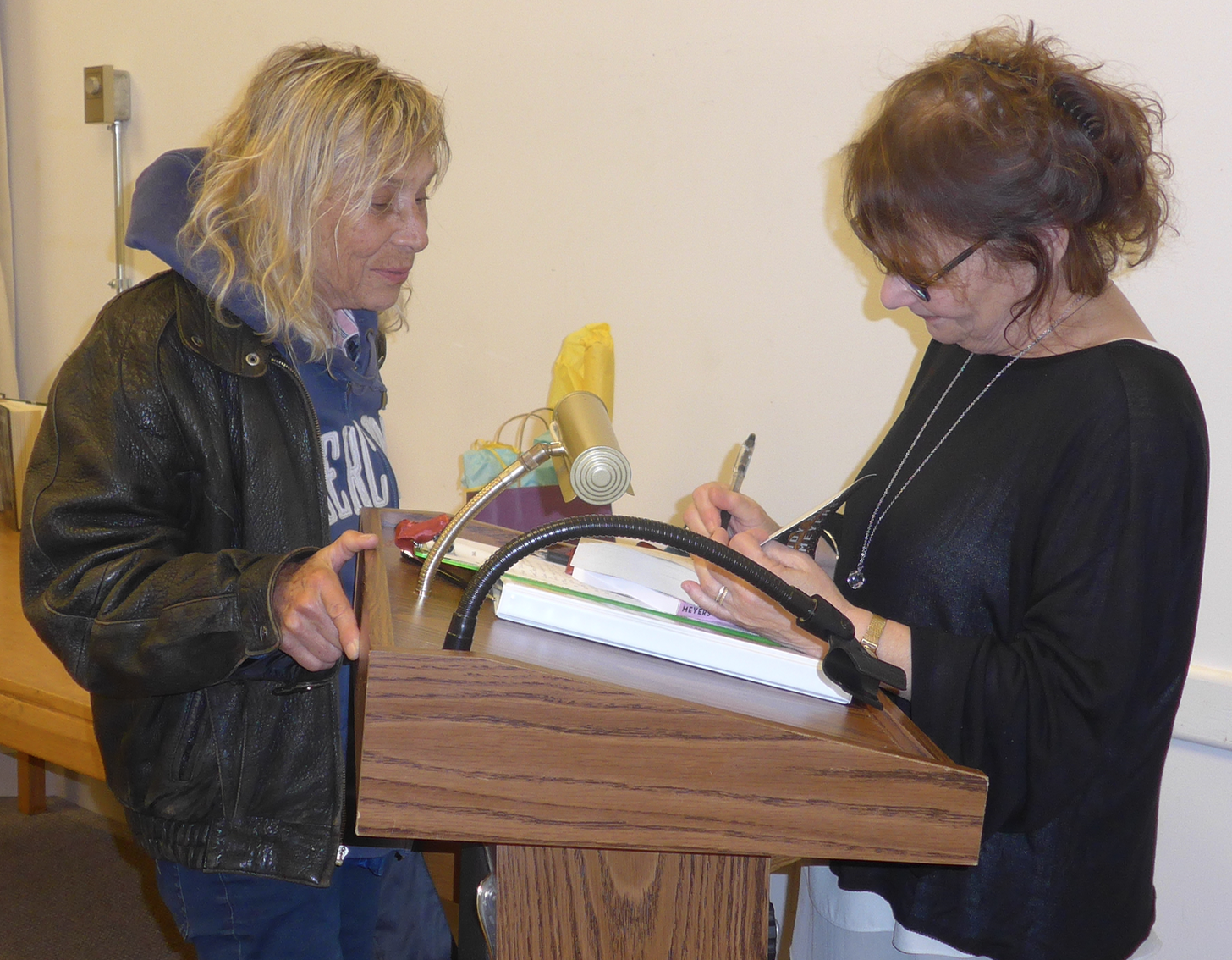
That little library was also the first place where she lied, Meyers confessed: She would get a ‘smart’ book that she knew she’d never read and put it on top of the pile of books she really wanted. “I didn’t want the librarian to think I was a dope,” she said. “But I didn’t really read smart books.”
It was perhaps the first step on a long road of better lies and other misdeeds like regular shop lifting when a teenager. This was followed by years of working with families impacted by violence, counseling convicted criminals out on probation and coming to terms with a father who tried to murder her mother that helped her write the fictionalized character of her latest book, The Widow of all Street. Based on the Bernie Madoff Ponzi scheme, the novel’s character, Jake, was a nasty guy. “I had to find a way to get into his head,” Meyers said. Focusing on her life experience, including her own transgressions, made that possible for her.
Meyers published her first novel at fifty-seven, her version of winning the lottery. The Widow of Wall Street, her fourth, is told from two points of view: Jake, a man with a criminal lust for money, and Phoebe, his wife, who had no idea. What would it be like to be Madoff’s wife? Meyers asked herself, to be married to a man who pulled the wool over the eyes of the Securities and Exchange Commission and many captains of industry? “What I learned is how different one spouse’s idea of a marriage can be from the other, and how often the children are collateral damage,” she said. The arc of her fictional themes represents her personal long journey from idolizing “bad boys” to “loving a good man.”

The Widow of Wall Street, was called an “engrossing emotional journey” by Kirkus Review, and “compelling” by the Associated Press. Library Journal wrote it was “full of deceit, scandal, and guilt" and that it "expertly explores how rising to the top only to hit rock bottom affects a family. The consequences will leave readers reeling.” Meyers, who describes her latest book a roman à clef, in which real people or events appear with invented names, is a form of fiction she enjoys reading herself. The author won the 2015 Must Read Fiction Massachusetts Book Award for her earlier work, Accidents of Marriage. The Boston Globe reviewer said Accidents, which explores emotional abuse in an educated but stressed-out family living in a Jamaica Plain Victorian, a 'complex, captivating tale.' It was chosen by People Magazine as "Pick of the Week."

Iory Allison, Blogger, Collage Artist and Author of "Glamour Galore Trilogy" Calls Libraries "the Great Cultural Achievement of Our Country" and Public Lending "An Invention"

Iory Allison, whose profile’s adjectives include world traveler, blogger, and husband to Leo Romero of Back Bay's Casa Romero where he was a host for 20 years. He came to the South End library in early September to talk about his Glamour Galore Trilogy , newly completed with Book Three, titled The Mermaid and the Sailor?
He described it as a sequence of mystery, farce and romance, a set of gay novels “to escape from the mundane drudgery.” Each book shows different characters, starting with those in an old Bostonian family which loses its jewels, and the subsequent books in the series shifting locale to gay clubs and its visitors.

Iory Allison speaking about his life’s work at the South End library in September
Allison grew up in New Canaan, CT, with a father plying his trade as an advertising man who wrote theatre and nightclub reviews for local papers on the side, in a house where family life “was centered around the library.” He began his trilogy in 1990 in the Boston Atheneum, where he wrote mornings, five days a week. Relying on his imagination but using material from his own life, he took three years for each novel in the series. Exhibiting an affinity for words, which he describes as “ancient magic,” he suggested that “the history of a word will reveal much of its meaning to you.” The name “Iory” is Welsh, Allison explained, with an original meaning of ‘fair lord.’
Almost two decades ago, Allison learned how to build a website from a certain Vlad, who he described as ‘a tech-savvy refugee from the newly collapsed USSR.’ Acquiring website skills allowed Allson to develop a blog and, eventually, another skill, namely digital collages. The blog illuminates “subjects near and dear to me,” Allison said, including adventures by himself and husband Leo. The collages can be found on the covers of his books which he designed himself but were influenced by, among other artists, Joseph Cornell. Once familiar with it, he found himself able to work more precisely and to discover a treasure trove of images to use. “So after resisting it for a long time, I’m now ok with digital collaging,” Allison said. “I especially like edges that are faded out.”
In this being, at the end of his talk, Allison wanted to say something about libraries: “Libraries, public or private, are the great cultural achievement of our country,” he said. “And free public lending is an invention.”
A Refreshed and Much-improved Library Park Has Been Reopened, but New Park Furniture Is Still on Back Order and Trees Are Awaiting their Pruning

A broad plaza/walkway leads from the South End branch to the park entrance at Rutland Square. The chairs in the image were in good-enough condition to preserve for the newly improved park.
Library Park was reopened to the public featuring a beautiful wide concrete walkway plaza with new paver detail strips that have replaced the broken bluestone surface and worn-out concrete-and-brick benches of previous decades. Four black single seats that were in Library Park before have been re-installed, and as soon as new park benches and cafe tables arrive from the back-order planet they, too, will become part of the green space's landscape.

The new furniture for Library Park will be added to the already installed chairs saved from the previous park layout.
The contractors laid down a new sub-base for the plaza and amended the impoverished soil where plantings struggled to live. A huge load of mulch has topped off the garden areas to help new plantings thrive and shine. How to landscape the park will be the subject of discussion this fall with the Parks Department, the BPL (which officially owns the site) and the FOSEL board.

There are still several projects left to be done, including the pruning of the trees which. according to Lauren Bryant, the Parks Department's project manager for Library Park, will be done in the next couple of weeks. The brick edging along Rutland Square will be reset for a smooth transition into the park. In addition, the two LightWells, for which the electrical wiring has been placed underground by the contractors, will need to be refurbished and the areas around them re-landscaped. Once upon a time, before the rats chewed through their wiring and vandals tried to skateboard over them, they were nicely landscaped seating areas that glowed in a series of hues through the night.
In the New Era of #MeToo, Author Karen Day Describes her 2018 Debut Novel, "I'll Stay" as a 'Testament' to a Time when Girls Stayed Quiet

Author Karen Day signing copies of her debut novel, I'll Stay.
Karen Day, a successful author for middle-grade readers (A Million Miles from Boston, No Cream Puffs, and Tall Tales), spent the better part of the last decade writing a novel about close friendships between young women and young women and their mothers. Day's 2018 debut novel for adults, I'll Stay, examines the relationship between Clare and Lee, college friends who on a vacation experience a traumatic event that negatively changes Lee's life forever, while Clare, the daughter of a famous mother, is able to flee to safer grounds. In the novel, the friends went back to school. They didn't talked about the event. The story is narrated by Clare at three different times, 1983, 1986 and 1991.

The plot was based very loosely on an incident in Day's own life when she and three college friends went backpacking. They found themselves in a scary situation, surrounded by men, but were able to escape unharmed. They returned to school and never talked about it, either. "It was as if nothing happened," said Day, who ever since wondered why not. "We didn't do it because in those days we didn't do things," Day says now. "We blamed ourselves: We said it was our fault because we flirted with those guys. We questioned our behavior."
Enter the #MeToo era, when Day's book, written before it was okay for women to publicly point the finger at men behaving badly, but published after. Day, a frank and engaging speaker who appeared unafraid to re-examine the premises of her own work, told the audience at the South End library in June that in writing I'll Stay, she explored where stories come from beyond the words on the page, looking to discover who she and her friends were, and how conflicts between them affected their friendships. She now sees her novel as "a cautionary tale about the impact of split-second choices" and a "testament to how easy it is for girls to stay quiet."

Novelist Day describing her search of where stories come from and how they evolve.
Day has been writing since she was a child growing up in Indiana, and came East to go school. She was a journalist for newspapers and magazines in the 1990s, and among other articles secured the last interview with tennis champion Arthur Ashe. She has a BA in Journalism, an MA in English Literature and taught undergraduate composition when studying for her doctorate at NYU. With her husband, she raised three children, getting up mornings at 4:30, often with her kids next to her in the beanbag chair, she said. It took her twenty years just to learn how to revise.
I'll Stay was the 2017 winner of BUZZ Books; a previous speaker at South End Writes, Jenna Blum, the author of Those Who Save Us, and The Lost Family, called it a “smart, compassionate, psychological spellbinder” with “one of the scariest scenes you’ll read anywhere.” The novel got a starred review from Publisher’s Weekly.

Mayor Walsh Adds Funding to FY19 City Capital Budget to Keep Renovations of South End Library and Library Park on Track

Mayor Marty Walsh speaking at a Coffee Hour in Titus Sparrow Park in early May about his commitment to South End's needs, including the renovations of Library Park and the South End Branch Library of the BPL

The proposed layout of the South End library's downstairs interior representing Phases One and Two by architect and FOSEL board member Michelle Laboy

Library Park's redesigned space, for which construction will commence the week of July 16, 2018. In addition to the design above, enthusiastically approved by the South End Landmark District Commission in April, the work will include major infrastructure work to remove any obstacles still buried underneath from the early 1970s when it was first built, and re-grade the park's surface.

Library Park in its previous state, with a large area of broken pavement and limited usage options. The new design, featured above, will have multiple seating arrangements. The construction, which began late July, may take three months.
The Friends of the South End Library (FOSEL) is very happy to report that, late last week, capital funding of $400,000 was restored in the FY 2019 budget for Phase Two of the South End library's interior renovation. This means that our efforts to quickly improve a cramped and outdated branch by means of a pubic/private partnership between the Boston Public Library (BPL) and FOSEL will succeed. It is the first partnership for a Boston branch library in the history of the BPL in which private contributions raised by FOSEL from local library supporters combined with a dedicated BPL capital allocation is used for an accelerated library renovation. In addition, money was added to the Parks Department budget to start the reconstruction of Library Park.
The current 2019 city budget, linked here, shows two capital allocations for the South End branch, $100,000 for a program study leading to a major overhaul and expansion of the library; and $400,000 to be spent on short-term improvements outlined in Phase Two. Both projects will be subject to public hearings. The proposed redesign for Phases One and Two is illustrated in the drawing above. Further details are on our website, linked here.
There are many people to thank, but first and foremost Mayor Marty Walsh, who visited the library several times since his election and each time pledged his full support for the branch's renovation, and for the redesign of the library's adjacent green space, Library Park. This spring, both library and park projects were suddenly delayed, each for different reasons, but both were put back on track with the same solution: the Mayor's strong support for more funding for these two important and long-neglected civic spaces in the South End.
The unwavering efforts on our behalf by District 2 Councilor, Ed Flynn, was another key factor. Flynn and his staff rallied the South End's other two councilors, Frank Baker (District 3) and Kim Janey (District 7), and all at-large councilors (Michelle Wu, Ayanna Pressley, Annissa Essaibi-George and Michael Flaherty), to sign their letter requesting the necessary funding from BPL President David Leonard and Mayor Walsh. Flynn met separately with the Mayor, as well, to plead FOSEL's case. The signature of City Council President, Andrea Campbell, who grew up in the South End, moreover, was at the top of the list.
Faisa Sharif, the South End's liaison to the Mayor's Office, performed a yeoman's job going through the budget details with David Leonard to secure city dollars for park and library, and kept FOSEL in the loop at all times. Our State Rep., Byron Rushing, a BPL trustee since 2009, assured audiences at several South End events recently that 'all would work out fine.' Did he know something we did not? Who knows: He was right.
Our BPL partner in the public/private enterprise, President David Leonard, has reached out to us to plan the next steps in the library project in meetings that will include Faisa Sharif, Ed Flynn and Byron Rushing. We are looking forward to continuing our productive relationship to benefit the South End library and its users. You will be kept apprised of important details.
Last but not least, we thank you, our loyal supporters, and every member of the FOSEL board, for emailing and phoning our elected representatives and the BPL. The turnaround could not have happened without you.

Harvard Public Health Professor, David Hemenway, Believes the CDC Can Help Prevent Gun Violence With a Campaign Similar to the One That Cut Fatalities from Car Crashes by 85 Percent in the 1950s

The numbers are mind-boggling: Since 1968, more Americans have died from guns in the United States than on battlefields of all the wars in American history. And if we do nothing about it, one million Americans will be shot in the next decade. Thus according to the June 5 speaker at the library's South End Writes series, David Hemenway, Professor of Health Policy at Harvard University, and Director of its Injury Control and Research Center. He presented a picture of a gun culture in the United States that he, and many of his public-health colleagues, believe is unnecessarily violent and destructive. He proposes a multi-faceted public-health approach of changing laws and norms that would reduce the lethal consequence of Americans' affinity for gun ownership to more acceptable levels.
Hemenway's public-health mantra is: Make it easy for people to stay healthy and difficult too become sick or injured. In other words, focus on prevention to benefit the entire population and switch the focus on gun-violence reduction from the curative (actions to heal individuals after gun violence has occurred) to the preventive (forming a broad and inclusive coalition with shared responsibilities to eliminate harm to the population at large).

David Hemenway, economist and Professor of Health Policy at Harvard University's Injury Control Research Center and the Harvard Youth Violence Prevention Center, wants to switch the gun debate from 'who's to blame' in gun fatalities to 'what causes the injuries?' and find broad-based solutions to cut the death and injury rates
The author of Private Guns/Public Health and While We Were Sleeping: Success Stories in Injury and Violence Prevention, Hemenway has solid reasons to believe he is right. He cites the powerful example of the US Center for Disease Control (CDC)'s great public-health accomplishment of the 20th century, namely the 85-percent reduction in deaths resulting from motor vehicle accidents. In the 1950s and 60s, public-health physicians changed the question from "who caused the fatal car crash?" to "what caused the injury?" Instead of blaming the driver every time for drinking while driving or running a red light, just as today 'irresponsible'gun owners are blamed for gun violence, researchers in the 1950s looked at what caused the injuries. They found that the quality of the vehicles and the prevailing condition of the roads and highways were sub-par, and often major factors in the fatalities. Resulting safety mandates for automobiles (seatbelts, car seats, head rests, safety glass) and highways (removal of telephone and light poles, trees and better signage) eventually cut the death rate of car fatalities by four-fifth.

Boston police Commissioner, Bill Evans, who introduced David Hemenway, had to leave early: Someone had been shot....
"Just as banning cars was not an option then, neither is banning guns now," Hemenway points out: More than a third of American households own guns. But the unrestricted use of guns and weak gun-control laws that prevail today come with a high cost, financially and emotionally. In the 1990s, the medical cost of gun shot injuries and death was estimated at $6 million a day. Gun injuries are the leading cause of uninsured hospital stays. The best estimate of the price tag of gun violence is about $100 billion a year. The consequences of the emotional trauma of participating in or witnessing gun violence can last a lifetime, he says, and the routine injuries to brain and spinal cord are devastating.

Hemenway, who won the Excellence in Science Award from the American Public Health Association and has been recognized by the CDC as one of the twenty most influential injury and violence prevention professional, proposes a multifaceted approach of harm reduction in which no one is blamed but everyone involved in the gun debate participates to find a broad-based solution. The goal is to reduce fatalities by, among other things, lifting the ban on research into gun usage, now mandated by the Dickey Amendment, in place since the mid-1990s. This would produce solid statistics as to why in the US the suicide rate is 12 higher than in similar developed countries, or why homicides here are 18 times higher. "Outside the US, countries have similar rates for violence, crime, bullying and aggression/depression rates among children," Hemenway says. "The only difference seems to be that Americans own an enormous number of fire arms." However, the CDC's so-called Behavioral Risk Factor Surveillance System (BRFSS) which collects state data about U.S. residents regarding their health-related risk behaviors, can't include questions about gun ownership or gun violence in their interviews, or risk losing CDC funding.

Hemenway's response to 'what we need to know about fire arms research' can be answered in one word: Everything. Specifically, the subjects to be researched include gun theft, gun training, open gun carrying, gun storage, gun suicide, gun accidents, gun threats, gun use in self-defense, gun use to intimidate, guns in intimate partner violence, straw purchasers, smart guns, effect of gun laws, gun law enforcement, gun transfers, gun shop practices, concealed gun carrying, guns on college campuses, guns at work, guns and alcohol, police and guns, assault weapons, Saturday night specials, penalties for illegal gun use, gun trafficking, liability laws and guns, insurance for gun owners, women and guns, children and guns, minorities and guns, Second Amendment, gun ranges, guns and hearing loss, guns and lead poisoning, gangs and guns, background checks, police discretion, machine guns, burglary, home protection alternatives, and so on.
Boston's Police Commissioner, Bill Evans, a strong proponent of strict gun laws, who joined the Boston Police Department as a rookie in 1980, introduced Hemenway for his talk at the South End library. Regrettably, the Commissioner could not stay long after his introduction. He was called away to a public-safety emergency..someone had been shot.

Acclaimed Novelist and Short-story Writer, Allegra Goodman, Delves into the World of Teachers and Gamers, the Focus of her Latest Book, "The Chalk Artist"

When the acclaimed author of short stories and novels, Allegra Goodman, came to the South End library in May, she pointed to a list of 20 names at the beginning of her latest novel, The Chalk Artist. "These are all my teachers," she said. "The first one was Dana Izumi, my Kindergarten teacher; the last, Stephen Orgel, was my dissertation advisor at Stanford." Listing them wasn't just because she ran out of relatives to thank, she joked: "Think of who was your best teacher: probably the one who was toughest on you," she said. "I was not a good student. I was left-handed. I had terrible handwriting. Miss Izumi used her blue pencil freely but she never gave up on me. Actually, I was in love with her. She had a page haircut. She was beautiful."

Author Allegra Goodman with FOSEL board member, Maura Harrington
Now a prize-winning author whose Kaaterskill Falls novel about a reclusive Orthodox-Jewish community summering in upstate New York was a finalist for the National Book Award, Goodman's research for The Chalk Artist took her to public high schools in Boston, where she found classrooms that were chaotic and problematic with overwhelmed teachers. She saw the demoralization of the teachers, which was also reflected in the students. "No one wanted to be there," she commented. One of the characters in the novel, a young teacher from a wealthy family who wanted "to give back" finds herself having to teach students obsessed by gaming, lured away from 'real life.' To explore that angle of The Chalk Artist, Goodman studied gaming, even creating her own graphics for invented games. As a traditionalist who, when interviewed by The Boston Globe, said her favorite app is a book, and, no, she doesn't text, she was an unlikely person to dive into that world. She concluded that gaming is more social than anything, with a massive audience and multi-game players. "Gamers look for community on-line and engage in elaborate role-playing on-line," she observed. "My book is not about 'literature is good and screen time is bad," she added, "but about the importance of imagination and the push and pull between words and images."

Goodman grew up in Hawaii, in a conservative Jewish family of academics who taught at the University of Hawaii. She attended the same exclusive school as did President Obama, though at a different time. Her early stories about intricate family dynamics were published as The Family Markowitz. Her recent ones, Apple Cake and F.A.Q.s came out in The New Yorker, as she focuses her attention on different members of the fictional Rubinstein family of Boston, in clear-eyed but compassionate and often hilarious descriptions of long-buried grudges and unexplored conflicts that can surface unexpectedly at inconvenient times.
How belief systems are challenged by life's changes is the recurring theme in Goodman's books. Her earlier novel, Intuition, delves into the world of cancer researchers whose particular belief systems are challenged by the 'professional betrayal' of a post-doc whose girlfriend thinks his data are too good to be true. "The book came about when I was considering the various aspects of marital betrayal and began to wonder, 'what about professional betrayal'?" she explained.

Goodman described herself as an American Jewish woman writer, but elaborated that "we all own the language we share." She pointed to George Eliot wrote about doctors and Jews but was neither. "It's true that you need to know what you write about," she said "but you need to expand what you know."
A resident of Cambridge whose fourth child is about to leave the parental home, Goodman is about finished with another novel. A textbook she co-wrote with a colleague about the craft of writing will be published in the next year. Charmed by the South End where she now takes her youngest child to dance lessons, she promised to be back with her new book.

Megan Marshall's Acclaimed Biography/Memoir, "Elizabeth Bishop: A Miracle for Breakfast," Illuminates the Sestina, a Poetic Measure Used by Marshall in the Biography and by Bishop in her Poems.

Acclaimed biographer Megan Marshall, who first visited the South End Writes in 2014 to read from her Pulitzer-prize-winning biography of Margaret Fuller, returned on May 8 to find a room full of Southenders eager to hear all about her most recent, and widely praised, biography, Elizabeth Bishop: A Miracle for Breakfast. She was introduced by her colleague, author Joan Wickersham, who described Marshall as a "peerless biographer who does meticulous scholarly research so that you, as a reader, get to know her subject deeply."
Marshall, who also wrote The Peabody Sisters: Three Women Who Ignited American Romanticism, a finalist for the Pulitzer Prize in 2006 and winner of several other awards prestigious awards, had been accepted in 1976 in Elizabeth Bishop's last verse-writing class before the poet died, in 1979 at age 68. Bishop also had been a guest speaker in a Robert Lowell poetry workshop Marshall had attended in the early 1970s when she had hoped to become a poet herself. By that time, Bishop had been the Poet Laureate at the Library of Congress in 1949-1950, won the Pulitzer Prize for Poetry in 1956, the National Book Award in 1970, and the Neustadt International Prize for Literature in 1976.

Author Joan Wickersham introducing biographer Megan Marshall
The personal connection provided Marshall with the opportunity to innovate the biography of Bishop by interspersing it with her own memoirs, in short sections, as she moves through the biography, said Wickersham. "It is a meditation on how we know another person," she commented. "The memoir part is about Marshall NOT knowing Bishop because, in life, you know people by their role, but not the real stuff. After reading this book, I really knew Bishop."
Wickersham noted the structure of the Bishop biography echoes the sestina, a French poetry measure dating to the 12th century. It consists of six stanzas of six lines and a final triplet, and uses six particular words in a certain pattern. This is a form Bishop used in, among other poems, A Miracle for Breakfast, with the words Balcony, Crumb, Coffee, River, Miracle and Sun. Marshall took those very words to name the six chapters in the biography, using the sestina's poetic form, "to tell the story about the poet," as Wickersham put it.

Prize-winning biographer Megan Marshall speaking to admirers at the South End library
Bishop wrote both poetry and short stories, many of them published in The New Yorker,; since she produced only 100 poems, Marshall confessed she had thought hers would be "a short biography." But in 2011, archives no one knew existed suddenly became available after Bishop's last partner, Alice Methfessel, died. It Included letters of passionate love between Methfessel and Bishop, as well as four letters Bishop wrote to her psychoanalyst, Ruth Foster. “So the book became longer,” Marshall said. And darker.
The archives threw a new light on Bishop's harrowing childhood: her father's early death; her mother's confinement and death in an insane asylum; the molestation by an uncle. Bishop was raised by a succession of relatives in Great Village, Nova Scotia, and Worcester and Revere, MA. She attended Saugus High School, then Walnut Hill School in Natick and Vassar College in New York. Her well-to-do Bishop grandparents (their contracting company built the Museum of Fine Arts and the Boston Public Library) provided her with a financial stipend and paid for the custodial care offered by her mother's sisters in Revere.

Bishop was plagued by shyness, asthma, alcoholism, and a deep frustration that her poems took so long to produce. Marshall speculates the drinking bouts were perhaps a desire for oblivion over the pain caused by the tragic separation from her mother. A get-together her father's relative once had organized for her was so traumatic to even contemplate that Bishop fled. But in January 1977, Marshall and a few other students were invited by Bishop to a party at her home on Lewis Wharf in Boston. “Bishop was shy but had parties for friends," Marshal said. "The condo overlooked the harbor where, once "her great-grandfather may have landed."
Bishop did not see her love for women as problematic, nor, Marshal said, did her analyst, Ruth Foster. She even lived as a married couple in Brazil for more than a decade with the architect, Lota de Macedo Soares. "Bishop found ways to live near, or with, her lovers. She lived as she chose," said Marshall, 'but even though gay liberation had begun in the 1970s, neither she nor her later partner, Alice, were ever really 'out.'"
“There are always things I can identify with,” Marshall said of the subjects of her biographies. “Bishop’s unruly hair reminded me of an elementary school report I received where the teacher asked, 'Can’t Megan ever comb her hair?' And I did not know until I began to research the book that Bishop was interested in Early Music," she added, revealing she studied piano and harpsichord for many years herself.
Marshall, who is currently exploring the women in the life of Nathaniel Hawthorne, was asked what question she'd have for Elizabeth Bishop, if she were alive today. Marshall wondered about the letters to her analyst: Why did she write them? Were they ever sent? Did the analyst ask her to? Reading them, Marshall said, "was as if I was sitting in on the sessions.”

Author William Kuhn, Presenting his Light-hearted Coming-of-age Novel, "Prince Harry Boy to Man", Suggests a Monarchy Can be a Unifying and Positive Factor in a --Usually Contentious-- Democracy

Explaining the different strands in his life that led to his having become a tongue-in-cheek chronicler of the British monarchy, author William Kuhn told the audience at the South End library on April 10 that he could think of three: Growing up in Columbus, Ohio, as the 'typical Midwestern kid starved for glamour;' being the son of an Ohio State English professor who took the family to London for a sabbatical when he and his brother Fritz were still boys; and watching the opening of the British Parliament and suddenly wondering what exactly the role of a monarchy was in a modern industrial democracy.
"Some of my rivals had concluded it was an invented system meant to keep the proletariat down," he said. "But I came to the opinion that in a contentious democracy, a monarchy could be unifying and positive factor, albeit with a comic dimension." Starting out doing scholarly research, Kuhn subsequently wrote biographies about 19th-century British Prime Minister Benjamin Disraeli (The Politics of Pleasure: A Portrait of Benjamin Disraeli) and Jackie Kennedy Onassis (Reading Jackie: Her Autobiography in Books). His continuing interest in the British monarchy, including its comic dimension, resulted in Mrs. Queen Takes the Train, which became a bestseller that was optioned to be a motion picture.
"By Harvey Weinstein," Kuhn said ruefully. "The option expired."
The novel posited Queen Elizabeth, depressed after the death of Princess Diane, walking out of Buckingham Palace and taking the train to Scotland by herself, chased by a group of unlikely courtiers. "It took about eight months to write," commented Kuhn, "but it was more successful than anything else I'd spent much more time on until then." Having done research in the Windsor archives, he was invited to the Buckingham Palace Christmas party, where he met Princess Diane. "She looked more spectacular than ever," Kuhn recalled, "with a beautiful red dress and red silk shoes. My academic colleagues would say, 'power to the people' but I said, 'yes, but did you see Princess Diane?'"
Researching Prince Harry Boy to Man, Kuhn saw that there were early indications of the rebellious personality of Prince Harry, which he illustrated with a picture in the accompanying slide show of toddler Harry sticking out his tongue to the photographer, while in his mother's arms. Unlike his older brother William, Harry was not a distinguished student and went straight into the army where he received officer’s training at Sandhurst. As second lieutenant, he was deployed to Afghanistan in 2007 but left within a few weeks after a UK media embargo on his time there was broken, which meant he could have become an enemy target. He was redeployed there later.
"There were a number of taboo images circulated by his army buddies, Kuhn said. "He was obviously a sexy guy, which is why I wrote about him,” he added dryly. He noted a similarity between the portrayal of King Henry IV by actor Alex Hassell in an ArtsEmerson production, in the arc of "troubled kid caught wearing a nazi unform, kicking out windows at a party, and his general lack of maturity" but eventually growing up as part of the British army. A segment of Prince Harry Boy to Man's dialogue was read by three event participants: FOSEL board member, Michael Cox; Kuhn's brother, Fritz; and writer Linda Markarian.
Answering audience questions, Kuhn said has not yet been invited to Harry’s wedding. Asked about his biography of Benjamin Disraeli (Benjamin Disraeli, The Politics of Pleasure), he said his interest in the 19th century British statesman, who became a Prime Minister, was piqued when he noticed the consistent homo-erotic themes in the politician's twelve books. His Jackie Kennedy Onassis biography (Reading Jackie: Her Autobiography in Books) was inspired by an exhibit catalogue of her dresses, which led him to look into her twenty years as a book editor for Viking Publishing and Doubleday. Kuhn tracked down authors still alive today who had worked with her, all of whom praised her editing skills, and saying she had 'improved their work.'

In addition to presenting a slide show, author Kuhn had three friends read part of the dialogue from a chapter in Prince Harry Boy to Man. They included FOSEL board member, Michael Cox, Kuhn's brother, Fritz, and author Linda Markarian.
Kuhn, a South End resident, is currently working on two projects: one on (Lord) Byron; the other about Tennessee Williams and Lilian Hellman.

The South End Landmark District Commissioners Approved the Proposed Library Park Redesign; Construction to Start in June
On April 3, the South End Landmark District Commission approved a revised proposal for the redesign of Library Park, as presented by the Boston Parks Department (see below). With their approval, came a compliment from the commissioners: "Thank you for having heard us," they told the Parks Department team. Construction is scheduled to start in June.
At the previous presentation to the SELDC in January, project director Lauren Bryant was asked to come back with an amended proposal to include the commissioners' concerns about protection of the park's oak trees root systems, easy flow of foot traffic unimpeded by park furniture and an upgraded, more interesting hardscape that would include some details of typical South End materials like brick, slate or bluestone. The redesign of the redesign was different enough to require a second public hearing about Library Park's future, which was held at the South End library on March 22. The commissioners praised the more dynamic design and the care that was taken to protect the trees.

The proposed re-design for Library Park that was presented to the South End Landmark District Commission on Tuesday, April 3
The March 22nd public hearing solicited a number of comments, including a request to create more intimate spaces through seating and paving areas. There was a question about what to do with the granite blocks that are a play opportunity for kids, but uncomfortable to sit on; a request to inset tables with game boards; and a concern that the seating feels restrictive given that it lines both sides of the plaza. The single chairs of the current park appear to be in good shape and will be re-used and matched in style with additional curved benches, cafe tables and chairs. The oak trees will be pruned.
A large part of the work will be devoted to improving the park's infrastructure, including the clean-up of the site, underneath which there is expected to be a great deal of remnants from previous housing, including oil tanks and a lot of bricks. The soil will be improved and re-graded to enhance future landscaping. Another important aspect of the reconstruction will be groundwater management and water filtration to benefit root systems of trees, shrubs and plantings.
At the first public hearing in November last year, Parks Department's Bryant and Brandon Kunkel, landscape architect with the Weston & Sampson design and engineering firm, presented attendees with three proposals. The one below was favored by the audience and was presented to Landmarks in January, but has been altered to comply with Landmarks's comments.

The re-design of Library Park proposed in January but not accepted by South End Landmark commissioners concerned about root system protection, foot traffic flow and the quality of the concrete hardscape.
After deducting the cost of design services, the remaining budget for the reconfiguration is $115,000, a small amount, which will be augmented with private fundraising efforts by the Friends of the South End Library until a more comprehensive renovation of library and park will take place in the next few years. Further information about the current project can be obtained at the Parks Department website, linked here.

State Rep Byron Rushing, in a Talk about his Political Career, Says the Most Gracious Thing in Our Politics is Finding Ways to "Be" in the "We"

In a room filled with admirers, friends and curious constituents, State Representative Byron Rushing reflected about his life as a social justice activist and politician in the Massachusetts State House, in a talk called My Life and Debt in the Massachusetts State House. The legislator quickly described himself as one of a select group of politicians, paid by constituents to represent them fairly. But “we are all politicians,” Rushing declared, though not necessarily paid. When teenagers succeed in convincing their parents to have a later curfew, they engage politically to get a rule changed. Changing rules or making new ones is all part of being politically active.
Rushing, who is up for reelection this November after 35 years in the Massachusetts House, said that what he engages in for his constituents comes out of his "understanding of who is in the 'we' of 'we the people.'" "If John Quincy Adams was here today, he’d be very surprised to see me in the Massachusetts legislature," he said. "That is my 'debt' to all those who fought to be in the 'we,' and my guide to the politics I engage in."
As soon as the words "we, the people," were written down centuries ago, no one could agree on who “we” was, Rushing said. "When the Constitution was written, most of the adults in the US could not vote. People knew way back when that 'we' was not everybody. The most gracious thing in our politics is," said Rushing, "that people could find a way to be in the “we.” Even though Thomas Jefferson owned and sexually abused people, he said, among them were those who heard the words, 'we the people' and figured out ways, as he put it, "to be the 'we'".
Rushing, currently the Assistant Majority Leader of the Massachusetts State House, has represented the Ninth Suffolk district since 1983, succeeding the influential South End social justice activist, Mel King, who spoke at the South End library last year. Rushing sponsored the law to end discrimination on the basis of sexual orientation in public schools, as well as the original gay rights bill in Massachusetts. He also led the effort for Massachusetts state pension funds to invest in the development of poor communities in the state, among many other efforts to promote equal justice in the state.

During the 1960s he was active in the civil rights movement, working for the Congress of Racial Equality (CORE) in Syracuse, NY, and as a community organizer for the Northern Student Movement in Boston. He directed a group of organizers, Roxbury Associates, who helped found the Lower Roxbury Community Corporation, one of the first community development corporations in the nation, and began some of the earliest organizing efforts in black communities against the war in Vietnam.
From 1972 to 1985, Rushing was president of the Museum of Afro-American History, when it purchased and began the restoration of the African Meeting House, the oldest black church building in the United States. In 1979, Rushing oversaw the lobbying effort in Congress to establish the Boston African American National Historical Site, a component of the National Park Service. Byron led the Museum in the study of the history of Roxbury for which the Museum conducted the archaeological investigation of the Southwest Corridor for the MBTA. As a legislator he sponsored the creation of Roxbury Heritage State Park and occasionally leads walking tours of African American and working class neighborhoods in Boston and Roxbury.

Having attended Harvard College and MIT, Rushing is an elected deputy to the General Convention of The Episcopal Church; a founding member of the Episcopal Urban Caucus; and serves on the boards of the Episcopal Women's Caucus and the Episcopal Network for Economic Justice. His priorities are and have been human and civil rights and liberties; local human, economic and housing development; environmental justice and health care.
In 2010, Rushing was appointed a trustee of the Boston Public Library by Mayor Thomas Menino, who was under fire at the time over his unfortunate attempt to close up to a third of the BPL branches. His appointment was seen by library advocates as a signal that, as long as Rushing was a BPL trustee, no libraries would be closed in Boston.