
BPL President Amy Ryan Thanks FOSEL for Funds Raised to Pay for the Installation of a Handicapped-Accessible Door at the South End branch
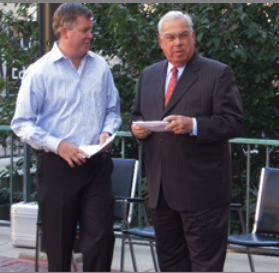
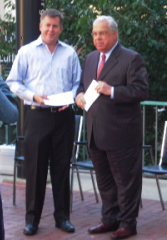
FOSEL president Glyn Polson and Mayor Thomas Menino
The Friends of the South End Library (FOSEL) received a letter of thanks from the president of the BPL, Amy Ryan, thanking the organization for its check to pay for a handicapped-accessible door at the South End branch. Glyn Polson, the president of FOSEL, applied for a grant to pay for the door from Pru-PAC last and received a check a few weeks ago. PruPAC is a fund established by developers 25 years ago to benefit neighborhoods around the Prudential Center. The Prudential Project Advisory Committee, a city-formed group composed of neighborhood residents and business representatives, had awarded the grant earlier this year. . The Friends of the South End Library was among a dozen of downtown non-profits that collected a total of more than $210,000 from the PruPAC fund recently.Once installed, the library will be one of a handful of BPL branches that is fully handicapped accessible. An elevator to the second-floor community room was added to the building in previous years. Polson is working closely with the BPL’s Facilities Department to complete the project as quickly as possible.
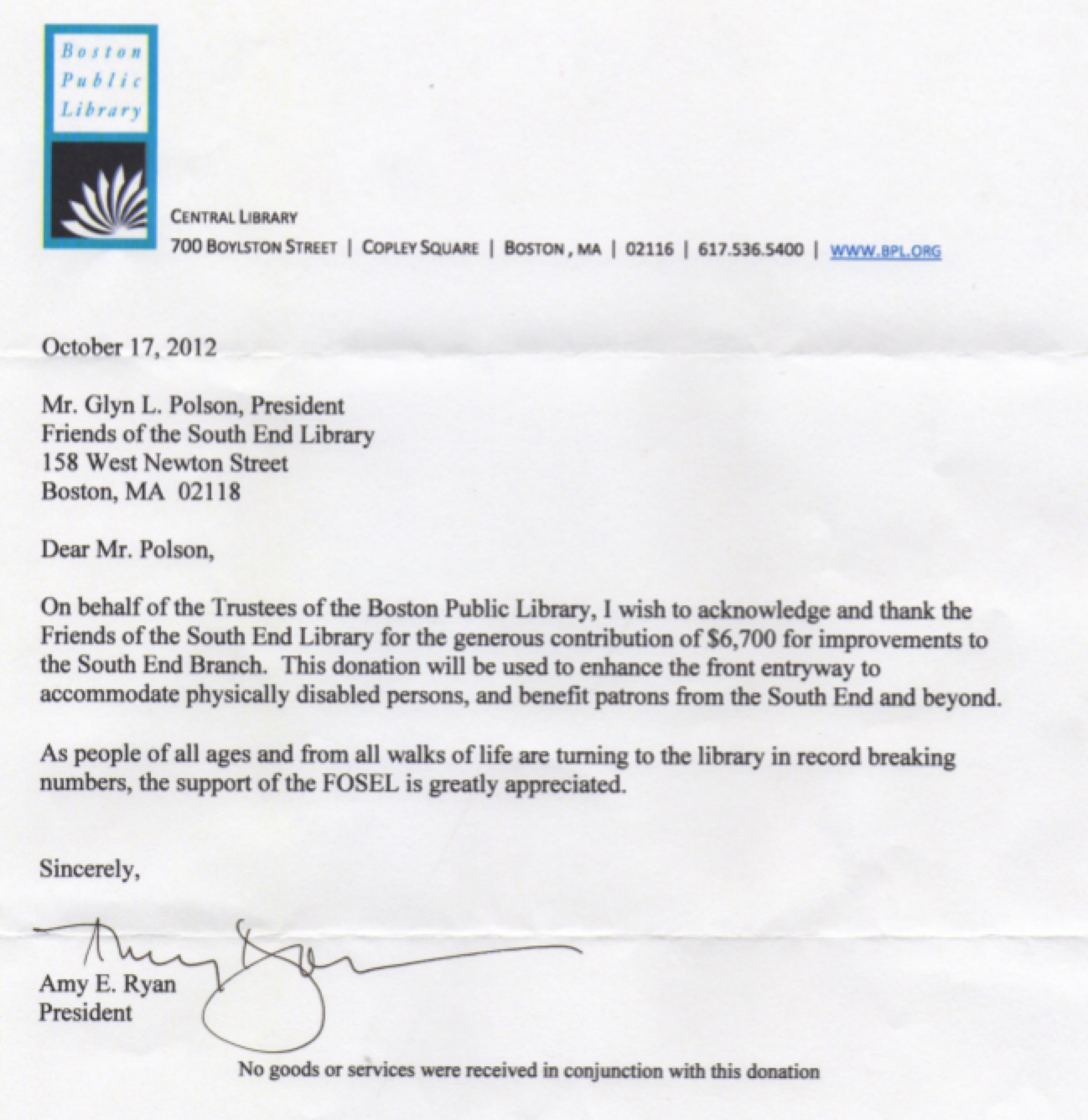
According to Christine Schonhart, director of branch libraries at the BPL, electricians will meet with the contractor at the branch next week to review the door and set a schedule. "While we won’t have to close the branch to install the switch, there might be some disruption to the entrance for people to move around the workers," she wrote. Further details will be posted as soon as they come over the wire...
The BPD's Archivist Margaret Sullivan and her Colleague Dr. Kim L. Gaddy Shine a Light on the History of Boston's Fairest

After personnel files were put on microfilm at the Boston Police Department in the 1970s, a sergeant detective about to retire dumped a box of women's roster cards on the desk of another, Kim L. Gaddy, saying she didn't have the heart to shred them. "That's how it all started," Dr. Gaddy told a rapt audience at the South End Library on October 16, during the slide show of "Boston's Fairest." With Margaret Sullivan, the BPD's archives and records manager, Dr. Gaddy spent hundreds of hours at Radcliffe's library and the "dank basement" of the BPL, among other places, to document the history of Boston police women.
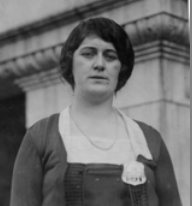
They only had to go back to the 1920s. The time between the two world wars was one of social change and the 1919 Boston Police Strike had decimated the department. It consisted of "rookies and old men," said Sullivan. In 1921 the first six women who had been allowed to take the entry exam were appointed. They were denied uniforms, weapons, cars and handcuffs. But they had their badge. They'd show it, presumably bark "you're under arrest," and haul the perps to the police station by hailing a cab. More women were hired in the 1940s, including the first African-Americans, among them Dorothy "Harry" Harrison, the daughter of physician Columbus Harrison, who practiced from his home on Chandler Street. "Can you explain why these women were placed in the South End which was one of the most dangerous parts of Boston?" one member of the audience wanted to know. "Because they were good," said Sullivan, "and they knew the district very well."
The BPD remained largely the domain of men. But the perpetrators included women, as did of course the victims of crime. Handling female prostitutes or battered women caused discomfort among male law enforcement. The female recruits were expected to focus on women by protecting them from "mashers" (men who'd harass them) and bring home lost children. They did that --even bought kids ice cream on the beaches of South Boston-- but would land punches, if necessary, with the best of them.
Despite nine decades of proving their worth, the BPD’s percentage of female officers is still only 14 percent, roughly on par with the police departments elsewhere. “Police work has a very macho image but it is 85 percent social work, instead of knocking heads” said Dr. Gaddy, explaining part of the reason why women many not even see police work as suitable for them to this day. Answering another audience question, the speakers affirmed no specific efforts are underway by the BPD to demystify what this profession is all about. "It's hard to get across why police work might appeal to college women" now looking to make career choices, agreed Sullivan. "It's not the only barrier," she said, referring to other disincentives: jobs are not necessarily there right now, you have to be put 'on the list,' you have to live in Boston, there are several tests. "By the time you take care of that, most will have made other choices," she said.

The first African-American female olice officer, Dorothy Harris
A few years ago, Sullivan helped uncover the history of Boston's first African-American officer in the BPD in 1878, Sgt. Horatio J. Homer. She is currently working on the biographies of some twelve police officers (she calls them her "dirty dozen") who made difficult choices in their careers, including resigning when that was 'the right thing' to do. "It's hard to be a good cop sometimes," Sullivan said. One of her subjects is a former resident of Rutland Square, Captain Francis Wilson, whose father, Butler Wilson, a staunch Republican, helped start the Boston branch of the NAACP.
Short-story Writer Maryanne O'Hara Will Read from her Debut Novel, "Cascade," Thursday, October 25 at 6:30 PM
maryanne ohara
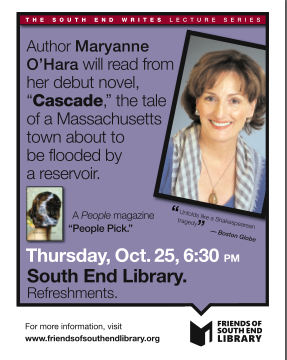
Maryanne O'Hara's first novel, Cascade, provides a fictionalized account of the attempted flooding of a small town in Western Massachusetts. Something like this really happened, of course, in the 30s, when the creation of the Quabbin reservoir 65 miles east of our fair city flooded not just one, but four towns: Dana, Enfield, Greenwich and Prescott.
The image of a drowned town once alive with community and history has been an enticing one for storytellers, including South End novelist, Sue Miller, who also used the metaphor in her 2001 novel, The World Below.
O'Hara's Cascade refers not to the flood, but to the actual town in which the main character, Desdemona, is born and raised. When Cascade is jeopardized by the damming of a nearby river, she fights for her own survival as an artist and a wife, as well as the town's. "Gorgeously written," said Caroline Leavitt, who reviewed it this summer for The Boston Globe.
O'Hara's reading on Thursday, October 25, starts at 6:30 p.m. Copies to borrow, buy and sign are available at the event.
Dr. Sara Lawrence Lightfoot Says Today's Seniors Seek to Redefine Success in Unconventional Ways During the Third Chapter of Their Lives
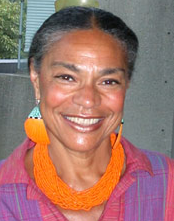
Dr. Sara Lawrence Lightfoot walked the 142 steps from her home in the South End to the local library the other day, where a packed room of neighbors and library patrons awaited her. "It's good to be home," she said appreciatively. Reading from her book, The Third Chapter: Passion, Risk and Adventure in the 25 Years after Fifty, the distinguished author and professor of sociology reminded the audience that, each day, 10,000 Americans turn 60. They are healthier, live longer, and represent a specific new demographic group in the 21st century the way 'adolescents' were newly defined in the 20th. They feel less bound by traditional rules, want to reinvent themselves more readily, and hope to leave a legacy that makes a positive difference. "We've honed our expertise," she said, "we're re-calibrating the meaning of success and want to look back and give forward."
In assessing what new thinking might help people navigate the Third Chapter more easily, Lawrence Lightfoot, who is the Emily Hargroves Fisher Professor of Education at Harvard University, focused on four areas:education, which by encouraging specialization at too early an age discourages later learning choices that may be very different but more suitable; the need for an intergenerational compact of 'respectful reciprocity' that reduces competition between young and old by means of mentoring and apprenticeships; crossing boundaries between race, class, gender and age to help us make a "bodacious leap of faith" into different arenas we may be fearful of; and a public discourse that uses imagery and innovation to infuse the purpose of our lives with a more collective view, rather than just individual achievement.
Elaborating on these themes in response to many questions, Lawrence Lightfoot suggested, for example, that in the classroom the concept of how long "wait time" can be matters. Referring to the time a child is allowed by the teacher to answer a question, wait time has been decreased to accommodate larger classes or packed curriculum requirements. But by asking too many questions that have only one correct answer, a child may not develop a necessary comfort level with open-ended questions, or those with multiple answers, and circumscribe new learning later on in life. In a different setting, the institutions people interface with daily, like banks or medical clinics, employees too easily refer to older people as "honey" or call them by their first name, infantilizing them. "We have to learn to say, "don't call us that," Lawrence Lightfoot stated firmly. With respect to her own Third Chapter transformations, she said she cares less about what people think of her, and that she has taken up long-distance swimming again.
Answering another question about her most recent book, Exit: the Endings That Set Us Free, Lawrence Lightfoot explained that it is not a sequel to The Third Chapter, but an exploration of the premise that we live in a society pre-occupied with beginnings. "We ignore the departures," she asserted. For this book, she looked at many 'exits' and found that instead of the negative space of regression and loss it is made out to be, it is a process that can unlock the regenerative powers 'that set us free.'.
FOSEL inquired whether the author would want to return to explore this subject further, and she did not turn us down. Stay tuned.
Sociologist, Educator and Author Sara Lawrence Lightfoot Will Read from "The Third Chapter: Passion, Risk and Adventure in the 25 Years After 50," Tuesday, October 9, at 6:30 p.m.
sara l lightfoot
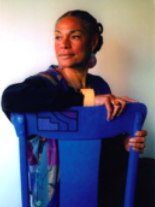
Sara Lawrence Lightfoot, a MacArthur prize-winning sociologist and Emily Hargroves Fisher Professor of Education at Harvard University, will be at the South End branch Tuesday night to talk about her book, The Third Chapter: Passion, Risk and Adventure in the 25 Years After 50. Written a few years ago when she had entered her sixties, Lawrence Lightfoot discards the notion that being over fifty means acting enthusiastic about new adventures and directions is either "inappropriate" or "undignified," or that just playing golf and leading a life of self-centered leisure is the recipe for successful retirement. Instead, she explores how the bulge of healthy but aging baby-boomers in the population snake is forcing a reconsideration of the options available in the --now extended-- later stages of life.
In her interviews with forty educated and financially stable men and women, the South End resident explored what motivates people in their 'Third Chapter' of life to want to learn something new, even when they have been very successful up till then and even if the new direction is difficult and has a high risk of failure. She asserts her subjects were no longer interested in making it to the top of the ladder of individual achievement but wanted to find a way "to use their privilege, skills, networks, and access for the benefit of the broader community."
Lawrence Lightfoot wants to know what "institutional innovations, cultural priorities, and educational reforms might support the translations from individual gain to public good?"
You wondered about that yourself? The South End library is the place to find the answer Tuesday night, where the author will be introduced by health coach and wellness counselor, Colette Bourassa.
Lawrence Lightfoot has written nine books, including The Good High School: Portraits of Character and Culture (1983), which received the 1984 Outstanding Book Award from the American Educational Research Association and Balm In Gilead: Journey of A Healer (1988), which won the 1988 Christopher Award.Her most recent book, Exit: The Endings That Set Us Free, was published in May 2012. Her selection of five favorite books can be found at The South End Reads. The event starts at 6:30 p.m.
Future South End Writes authors are listed below:
Tuesday, October 16, 6:30 p.m. BPD Archivist Margaret Sullivan and Sgt. Detective Dr. Kim L. Gaddy"Boston's Fairest," an exhibit and lecture about the first 50 years of women in the Boston Police Department by the BPD's archivist, documenting the careers of wives and mothers who took on gangsters and bootleggers.
Thursday, October 25, 6:30 p.m. Maryanne O'Hara a former associate editor at Ploughshares and oft-published short-story writer, O'Hara will read from her debut novel Cascade, a recent People magazine pick, and described as "richly-satisfying" by the Boston Globe.
Tuesday, October 30, 6:30 p.m. Margot LiveseyThe Flight of Gemma Hardy, the seventh novel of Scottish-born Livesey which just came out in paperback, is modeled on the English classic, Jane Eyre, a "risky move" at which she for the most part succeeds, according to the New York Times. Introduction by novelist Sue Miller
Thursday, November 1, 6:30 p.m. Stephen DavisMore Room in a Broken Heart: the True Adventures of Carly Simon, the unauthorized biography of one of the most gifted folk singers by a former Rolling Stone magazine's editor and (now former) Simon family friend.
Tuesday, December 4, 6:30 p.m. Victor Howes A South End poet, decades-long college professor of literature and World War II veteran who published poems and book reviews in the Christian Science Monitor for many years, will read from his selected work.
January 15, 2013, 6:30 p.m. Leah Hager CohenThe Grief of Others The author, who publishes both fiction and non-fiction, will read from her latest novel which the New York Times described as "her best work yet." With an introduction by Sue Miller
Tuesday, February 5, 6:30 p.m. April Bernard The poet (Romanticism)and novelist, most recently of history (Miss Fuller), is currently the director of creative writing at Skidmore College. With an introduction by South End author Doug Bauer
Tuesday, February 26, 6:30 p.m. Andre Dubus IIITownie, a memoir The examination of the author's violent past has been described "best book" of non-fiction of 2011 and 2012 by many literary-gate guardians, and was preceded by his previous novelsHouse of Sand and Fog (made into a movie by the same name) and The Garden of Last Days. Sue Miller will introduce the author.
Tuesday, March 19, 6:30 p.m. Mari Passananti will read from her second novel, The K Street Affair.
Tuesday, April 18, 6:30 p.m. Doug Bauer Editor, writer of numerous books of fiction and non-fiction, and revered professor of English at Bennington College (to where he commutes from the South End), Bauer will read from his most recent collection of essays, What Happens Next?, to be published in the fall of 2013 by the University of Iowa Press.
Tuesday, May 21, 6:30 p.m. Alice HoffmanThe Dovekeepers, a historical novel describing the AD70 massacre at Masada from the point of view of four women at the fortress before it fell during the Jewish-Roman war, is the most recent of the nearly two dozen novels by Hoffman and just came out in paperback. To be introduced by Sue Miller.
Tuesday, June 11, 6:30 p.m. Alice Stone, the local filmmaker whose mesmerizing documentary, Angelo Unwritten, has followed the life of a teenager adopted out of foster care when he was twelve, will return with an update of new material gathered since December 2011.
Tuesday, June 18, 6:30 p.m. Philip Gambonewill return to read from his current work-in-progress, retracing the steps of his father who, as a soldier, was sent to Europe during the Second World War.
A New FOSEL Section, "The South End Reads," Will List the Five Favorite Books of Each Author in "The South End Writes" Series, Starting Now..

ser
Since the start of The South End Writes series in 2010, members of the audience routinely asked what the authors themselves were reading. Unsurprisingly, they would come up with a number of tantalizing titles that immediately got lost in the hubris of subsequent questions, laughter, greetings, autographing of books, and clean-up as the library closed for the night. To rectify this, FOSEL will post each speaker's five favorite books, beginning this season. In addition, we'll try to, belatedly, find out from previous writers and poets what lives at the top of their lists. Here is what we can offer you now:Susan Naimark (09/20/12 "The Education of a White Parent: Wrestling with Race and Opportunity in the Boston Public Schools"):
1. The Warmth of Other Suns, by Isabel Wilkerson
2. The New Jim Crow, by Michelle Alexander
3. Country of My Skull, by Antjie Krog
4. The Education of a WASP, by Lois M. Stalvey
5. The Spirit Catches You and You Fall Down, by Anne Fadiman
L. Annette Binder (09/25/12, "Rise")
1. No Country for Old Men, by Cormac McCarthy
2. The Road, by Cormac McCarthy
3. Wonder Boys by Michael Chabon
4. Play It as It Lays, by Joan Didion
5. A Supposedly Fun Thing I'll Never Do Again, by David Foster Wallace
Sara Lawrence Lightfoot (10/09/12: "The Third Chapter: Passion, Risk and Adventure in the 25 Years after Fifty")
1. Still Alice by Lisa Genova
2. The Known World by Edward P. Jones
3. Plainsong by Kent Haruf
4. Brown Girl Brownstones by Paule Marshall
5. Interpreter of Maladies by Jhumpa Lahiri
Margaret Sullivan and Sgt. Detective Dr. Kim L. Gaddy (10/16/12:“Boston’s Fairest,” an exhibit and lecture about the first 50 years of women in the Boston Police Department by the BPD’s archivist, documenting the careers of wives and mothers who took on gangsters and bootleggers.)
1.Sarah's Long Walk: The free Blacks of Boston and How Their Struggle for Equality Changed America, by Stephen Kendrick and Paul Kendrick
2. THE SISTERS: The Saga of the Mitford Family, by Mary S. Lovell
3. DARK TIDE: The Great Boston Molasses Flood of 1919, by Stephen Puleo
4. A City in Terror : The 1919 Boston Police Strike, by Francis Russell. Digitized by the Boston Public Library at <http://archive.org/details/officersmenstati00tapp>http://archive.org/details/officersmenstati00tapp
Maryanne O'Hara (10/2//5/12, "Cascade")
1. Jane Eyre, Charlotte Bronte
2. Anna Karenina, Leo Tolstoy
3. Immortality, Milan Kundera
4. The Master, Colm Toibin
5. Selected Stories, Alice Munro
6. Collected Stories, William Trevor
Margot Livesey (10/30/12, "The Flight of Gemma Hardy")
1. Jane Eyre by Charlotte Bronte
2. The Fountain Overflows by Rebecca West
3. The Good Soldier by Ford Maddox Ford
4. Middlemarch by George Elliot
5. The Leopard by Lampedusa.
Stephen Davis(11/1/12, "More Room in a Broken Heart: the True Adventures of Carly Simon")
1. The Aleph, by Jorge Luis Borges
2. Collected Stories, by Paul Bowles
3. Offshore, by Penelope Fitzgerald
4. For Your Eyes Only, by Ian Fleming
5. Spies of the Balkans, by Alan Furst
Leah Hager Cohen (1/15/13, "The Grief of Others")
1. How Green Was My Valley, by Richard Llewellyn
2. Dime Store Alchemy, by Charles Simic
3. The Keeping Days, by Norma Johnston
4. Binocular Vision, by Edith Pearlman
5. Middlemarch, by George Eliot
Lynne Potts(1/29, "A Block in Time: a History of the South End from a Window on Holyoke Street")
1. The Baron in the Trees by Italo Calvino (fiction)
2. Pale Fire by Vladimir Nabokov (fiction)
3. Omenos, by Derek Walcott (poetry)
4. To the Lighthouse , by Virginia Woolf (fiction)
5. Black Lamb and Grey Falcon: a Journey through Yugoslavia," by Rebecca West (non-fiction)
April Bernard (2/5, "Miss Fuller")
1. Flaubert's Parrot by Julian Barnes
2. Geography IIIby Elizabeth Bishop
3. Virgil's Eclogues, translation by David Ferry
4. Villette by Charlotte Bronte
5. Desire by Frank Bidart
Andre Dubus III(2/26, "Townie")
1. Ironweed, by William Kennedy
2. Let the Great World Spin, by Column McCann
3. Any short story collection by Alice Munro
4. Bastard Out of Carolina, by Dorothy Alison
5. Dalva, by Jim Harrison
South End Writer L.Annette Binder Spins a Modern-day Fairy Tale With a Reading from her Short-story Collection,"Rise"

labinder -4-
"Freda weighed eighteen pounds when she was born. Her feet were each six inches long. At ten she was taller than her father." So began Nephelim, read by L. Annette Binder, from her award-winning debut short-story collection, Rise, at the South End Library recently. Husky-voiced, slightly swaying while leaning into her attentive audience, the author spun a magic tale of love and death, a dance between the physical fate of Freda and her all too human quest for love, which centers on the neglected boy of a neighboring family. Finely woven details describe the cruelty of physical deformity and the tenderness with which Freda's mother tries to find a place in the world for her doomed large child.
The former attorney, a classics major who was born in Germany but raised and educated in Colorado, told the listeners she finds the seeds of her materials from "something I hear on the street," or "a blip in the newspapers," but that what drives her stories is "character." Binder's first novel, unpublished, is stored in a 'lined desk drawer,' as she put it, but she is currently at work on another, based on a short story also included in Rise, called "Dead Languages." Binder's five favorite books are listed under The South End Writes tab on this web site.
Stephen Davis, Who Wrote the Unauthorized Biography of Carly Simon, Has been Rescheduled to Talk on November 1 at the South End Branch. Sara Lawrence Lightfoot Will Give a Talk on October 9.

sll2
Stephen Davis, the author of More Room in a Broken Heart: the True Adventures of Carly Simon has been rescheduled to talk at the South End Library on Thursday, November 1, instead of the previously announced date in early October. An interview opportunity for Davis's next book on Stevie Nicks was the cause for the delay. In an email to FOSEL, Davis promises an "excruciating evening of R & R lore unfit to print but fun to hear about." Fasten your seat belts on Tuesday, November 1. Harvard professor, former Mac Arthur fellow, and long-time South End resident Sara Lawrence Lightfoot will talk at the South End Library on Tuesday, October 9, about her book The Third Chapter: Passion, Risk and Adventure in the 25 Years After 50. It will start at 6:30 p.m.
Mayor Menino Hands FOSEL a Pru-PAC Check to Pay for the Installation of a Handicapped-accessible Door at the South End Branch
menino:glyn
The Friends of the South End Library was among a dozen group of downtown non-profits that received a total of more than $210,000 from the PruPAC fund, established 25 years ago by developers to benefit the neighborhoods around the Prudential Center.Glyn Polson, president of the South End library's Friends group, applied for the grant to help pay for the cost of an automatic door at the branch. Once installed, the library will be one of a handful of BPL branches that is fully handicapped accessible. The Prudential Project Advisory Committee (PruPAC), a city-formed group composed of neighborhood residents and business representatives, had awarded the grant earlier this year but not yet issued the check. Polson is working closely with the BPL's Facilities Department to complete the project as quickly as possible.

L. Annette Binder Will Read From her Award-winning Story Collection Tuesday, September 25, at 6:30 P.M. at the South End Library

Author and South End resident L. Annette Binder will read tomorrow, Tuesday, September 25, from her short stories collected in Rise, which won the 2011 Mary McCarthy Prize in Short Fiction in 2011. Binder was born in Germany, grew up in Colorado and attended Harvard University, Berkeley, and the Programs in Writing at the University of California, Irvine. Her writings have appeared in the Pushcart Prize Collection XXXVI and other publications. She is currently working on a novel based on her tale "Dead Languages," published in The Southern Review. Books will be available for borrowing from the library, private purchase and signing by the author. The event starts at 6:30 p.m. Below are future readings in The South End Writes series:
Tuesday, October 9, 6:30 p.m.
Sara Lawrence Lightfoot
The Third Chapter: Passion, Risk and Adventure in the 25 Years After Fifty, a review by the long-time Harvard University sociologist, educator, former MacArthur Prize fellow and South End resident, of the career and life choices people make before and after retirement. Introduction by health coach and wellness counselor Colette Bourassa.
Tuesday, October 16, 6:30 p.m.
Margaret Sullivan
"Boston's Fairest," an exhibit and lecture about the first 50 years of women in the Boston Police Department by the BPD's archivist, documenting the careers of wives and mothers who took on gangsters and bootleggers.
Thursday, October 25, 6:30 p.m.
a former associate editor at Ploughshares and oft-published short-story writer, O'Hara will read from her debut novel Cascade, a recent People magazine pick, and described as "richly-satisfying" by the Boston Globe.
Tuesday, October 30, 6:30 p.m.
The Flight of Gemma Hardy, the seventh novel of Scottish-born Livesey which just came out in paperback, is modeled on the English classic, Jane Eyre, a "risky move" at which she for the most part succeeds, according to the New York Times. Introduction by novelist Sue Miller
Thursday, November 1, 6:30 p.m.
Stephen Davis
More Room in a Broken Heart: the True Adventures of Carly Simon, the unauthorized biography of one of the most gifted folk singers by a former Rolling Stone magazine's editor and (now former) Simon family friend.
Tuesday, December 4, 6:30 p.m.
Victor Howes
A South End poet, decades-long college professor of literature and World War II veteran who published poems and book reviews in the Christian Science Monitor for many years, will read from his selected work.
January 15, 2013, 6:30 p.m.
Leah Hager Cohen
The author, who publishes both fiction and non-fiction, will read from her latest novel which the New York Times described as "her best work yet." With an introduction by Sue Miller
Tuesday, February 5, 6:30 p.m.
April Bernard
The poet (Romanticism)and novelist, most recently of history (Miss Fuller), is currently the director of creative writing at Skidmore College. With an introduction by South End author Doug Bauer
Tuesday, February 26, 6:30 p.m.
Andre Dubus III
The examination of the author's violent past has been described "best book" of non-fiction of 2011 and 2012 by many literary-gate guardians, and was preceded by his previous novelsHouse of Sand and Fog (made into a movie by the same name) and The Garden of Last Days. Sue Miller will introduce the author.
Tuesday, March 19, 6:30 p.m.
will read from her second novel, The K Street Affair.
Tuesday, April 18, 6:30 p.m.
Editor, writer of numerous books of fiction and non-fiction, and revered professor of English at Bennington College (to where he commutes from the South End), Bauer will read from his most recent collection of essays, What Happens Next?, to be published in the fall of 2013 by the University of Iowa Press.
Tuesday, May 21, 6:30 p.m.
The Dovekeepers, a historical novel describing the AD70 massacre at Masada from the point of view of four women at the fortress before it fell during the Jewish-Roman war, is the most recent of the nearly two dozen novels by Hoffman and just came out in paperback. To be introduced by Sue Miller.
Tuesday, June 11, 6:30 p.m.
the local filmmaker whose mesmerizing documentary, Angelo Unwritten, has followed the life of a teenager adopted out of foster care when he was twelve, will return with an update of new material gathered since December 2011.
Tuesday, June 18, 6:30 p.m.
will return to read from his current work-in-progress, retracing the steps of his father who, as a soldier, was sent to Europe during the Second World War.

"South End Writes" Speaker and Former School Committee Member Susan Naimark Lists "Ten Things She Wishes She'd Known" Before Sending Her Kids to Boston Public Schools

The South End Library hosted a rapt audience of more than fifty local parents last Thursday night to hear a talk by education activist and author Susan Naimark, who described her experiences as a Boston Public Schools parent in the 1980s and 90s, when she and her husband John guided three children, including a foster daughter, through eight public schools. "My kids got a great education, even though none received their first choice of school," said the former West Concord Street resident who moved to a Jamaica Plain fixer-upper to raise her family. She recalled that many parents at the time left the Boston public schools over court-ordered busing and mandatory school assignments but, despite years of a crazy schedule caused by both working full time and advocating for quality education in all public schools, Naimark stated firmly "I am glad we didn't bail."
Appointed to the School Committee by Mayor Tom Menino in the late 90s, where she served for a total of eight years, Naimark concluded that conversations about public education are often the wrong ones. "There are layers of dynamics around race, but we don't talk about race or racism," she said. "So I wrote a book about it." With The Education of a White Parent: Wrestling with Race and Opportunity in the Boston Public Schools, Naimark hopes to share her learning curve which, she said, is tied to national trends in public schools. "I gave a talk in Minnesota in June and parents there told me that what I had to say sounded just like what was happening in their kids' classroom today," she commented.
Searching for answers as to why so many students of color tested poorly --even though they seemed just as smart as her own white children-- or why selected school activities were dominated by white children, or why parents of color seemed less involved in school committees, Naimark looked beyond standard-fare responses that did not satisfy her. She reminded the audience that the parents, as elementary-school kids themselves, were bused to schools in hostile neighborhoods where they were stoned and spat on. "They may simply not be comfortable going to their kids' schools," she suggested. Pointing to a long history of advocacy by Boston's African-American community for better public schools, Naimark said that the first petition for school equity here was filed centuries ago, in 1798. And again in 1800, and 1840, and 1845 and 1846. The lack of responsiveness, or results, finally led to the Racial Imbalance Act of 1965, which culminated in court-ordered busing in the mid-seventies. During that time, the Boston public-school population declined from 60,000 to 40,000 students, when many white parents fled for the suburbs or private schools.
The question of why parents don't show up at their children's schools is complicated, Naimark emphasized, and differently complicated again for immigrant parents. There's a role for white parents in addressing this matter, she insisted, which starts with relationship building. To that point, she listed "ten things I wish I had known before I became involved as a Boston public-school parent," she said.
They are:
Stretch yourself to get to know others who are unlike you.
Racism and inequity are important for everyone to speak up about. The BPS has an Equity Office that will look into racist remarks. and related problems.
Make it a personal commitment to engage with those who appear left out.
Don’t take perceived hostility personally—decades of racism and exclusion leave their mark.
Make sure kids who are different get together.
Model how to talk about race and racism to your children, even if it is difficult and no immediate solution is in sight.
Don’t be defensive when you are challenged by parents of color: white liberals often appear most defensive about being called racist or making racist assumptions.
The impact of what you say or do trumps the intent. Don’t argue about it.
It’s ok to admit you don’t know certain things.
If you don’t work for ALL kids, you send the wrong message to your own kids
One of the audience participants said that "great stuff is happening" in many Boston public schools, and that there are resources available to help classroom teachers secure materials for their students, including DonorsChoose, an on-line charity that specializes in funding public-school projects large and small.
South End Library to Commemorate the Late Kirkland Oliver, Otherwise Known as "Peace," Thursday, September 20, at 6:00 P.M.
One of the South End's longtime characters, "Peace," passed away in August, and the South End branch will host a celebration of his life on Thursday, September 20, at 6:00 p.m. According to Alison Barnet, local lore chronicler who has a fine eye and ear for detail of South End's history, Peace was a self-taught collage artist who was once written up in the New York Times for the dashiki shop he and his wife ran in Hempstead, Long Island, NY. Peace claimed to have met Jimi Hendrix five times, and could be described as Hendrix's alter ego. "I, for one, am going to miss his good humor, his wacky fixation on masonic symbols and numerology, and his interest in my writing," reports Barnet in a commemorative article about Peace in the August 16 issue of the South End News. The event will be held downstairs at the branch and is open to the public. Donations of food and beverages are welcome.
"The South End Writes" Resumes Thursday, September 20, 6:30 p.m., with Susan Naimark Reading from "The Education of a White Parent: Wrestling with Race and Opportunity in the Boston Public Schools"
When Susan Naimark sent the first of her two sons into the Boston public school system in 1985, she found out quickly that she was getting an education herself. Not in academic subjects necessarily, but in how race and white privilege play out in the public-school classroom. The former South End resident who had moved to a fixer-upper in Jamaica Plains watched her children thrive, while many of their classmates of color did not, she writes. She wanted to know why. "To understand it from the perspective of white privilege, I had to hold up the mirror," says Naimark, who wrote "The Education of a White Parent:Wrestling with Race and Opportunity in the Boston Public Schools," from which she will read at the South End Library Thursday, September 25 at 6:30 p.m. Naimark was appointed to the Boston School Committee by Mayor Tom Menino in 1997 and re-appointed for a second term in 2000. She currently works in non-profit community development, and serves on boards of several organizations that work for racial justice and the improvement of the Boston public schools.
THE SOUTH END WRITES 2012-2013
Thursday, September 20, 6:30 p.m.Susan Naimark The Education of a White Parent: Wrestling with Race and Opportunity in the Boston Public Schools, a memoir of white privilege and unequal access as observed by a former Boston School Committee member
Tuesday, September 25, 6:30 p.m.L. Annette Binder Rise, an award-winning debut short-story collection by a writer born in Germany, raised in Colorado and now settled in the South End.
Rescheduled from Tuesday, October 2 to a to-be-confirmed date later this fall Stephen Davis More Room in a Broken Heart: the True Adventures of Carly Simon, the unauthorized biography of one of the most gifted folk singers by a former Rolling Stone magazine's editor and (now former) Simon family friend.
Tuesday, October 9, 6:30 p.m. Sara Lawrence Lightfoot The Third Chapter: Passion, Risk and Adventure in the 25 Years After Fifty, a review by the long-time Harvard University sociologist, educator, former MacArthur Prize fellow and South End resident, of the career and life choices people make before and after retirement. Introduction by health coach and wellness counselor Colette Bourassa.
Tuesday, October 16, 6:30 p.m.Margaret Sullivan"Boston's Fairest," an exhibit and lecture about the first 50 years of women in the Boston Police Department by the BPD's archivist, documenting the careers of wives and mothers who took on gangsters and bootleggers.
Thursday, October 25, 6:30 p.m. Maryanne O'Hara a former associate editor at Ploughshares and oft-published short-story writer, O'Hara will read from her debut novel Cascade, a recent People magazine pick, and described as "richly-satisfying" by the Boston Globe.
Tuesday, October 30, 6:30 p.m. Margot Livesey The Flight of Gemma Hardy, the seventh novel of Scottish-born Livesey which just came out in paperback, is modeled on the English classic, Jane Eyre, a "risky move" at which she for the most part succeeds, according to the New York Times. Introduction by novelist Sue Miller
Tuesday, December 4, 6:30 p.m.Victor Howes A South End poet, decades-long college professor of literature and World War II veteran who published poems and book reviews in the Christian Science Monitor for many years, will read from his selected work.
January 15, 2013, 6:30 p.m. Leah Hager Cohen The Grief of Others The author, who publishes both fiction and non-fiction, will read from her latest novel which the New York Times described as "her best work yet." With an introduction by Sue Miller
Tuesday, February 5, 6:30 p.m. April Bernard The poet (Romanticism)and novelist, most recently of history (Miss Fuller), is currently the director of creative writing at Skidmore College. With an introduction by South End author Doug Bauer
Tuesday, February 26, 6:30 p.m. Andre Dubus III Townie, a memoir The examination of the author's violent past has been described "best book" of non-fiction of 2011 and 2012 by many literary-gate guardians, and was preceded by his previous novels House of Sand and Fog (made into a movie by the same name) and The Garden of Last Days. Sue Miller will introduce the author.
Tuesday, March 19, 6:30 p.m. Mari Passananti will read from her second novel, The K Street Affair.
Tuesday, April 18, 6:30 p.m.Doug Bauer. Editor, writer of numerous books of fiction and non-fiction, and revered professor of English at Bennington College (to where he commutes from the South End), Bauer will read from his most recent collection of essays, What Happens Next?, to be published in the fall of 2013 by the University of Iowa Press.
Tuesday, May 21, 6:30 p.m. Alice Hoffman The Dovekeepers, a historical novel describing the AD70 massacre at Masada from the point of view of four women at the fortress before it fell during the Jewish-Roman war, is the most recent of the nearly two dozen novels by Hoffman and just came out in paperback. To be introduced by Sue Miller.
Tuesday, June 18, 6:30 p.m. Philip Gambonewill return to read from his current work-in-progress, retracing the steps of his father who, as a soldier, was sent to Europe during the Second World War.
"The King's Baroque" Musical Performance by Sauerwald and Finke Inaugurates Fall Season's Resumption of Saturday Hours at the South End Library, September 8, at 1:00 p.m.
...which is the positive way of describing the BPL's dismal policy to close branch libraries on Saturdays during the summer, when our children are out of school, and need library services the most. It is bad enough branch libraries are closed on Sundays and most weekday nights, when those of us who work during the day and pay taxes to support libraries, can get to them...Enuf said.. Back to..
The King's Baroque, a concert that will be performed at the South End branch on Saturday, September 8, at 1:00 p.m., by Janet Finke on the recorder and Dylan Sauerwald at the hapsichord. Finke is a member of Ensemble 44 which explores the works of Baroque women composers. Their first CD, Six by Three: 6 Sonatas by 3 Women Composers, was released last year and contains works of Elisabeth-Claude Jacquet de la Guerre, Anna Amalia von Preusen, and Isabella Leonarda. Dylan Sauerwald was hapsichordist for Opera McGill for several years, and is currently a graduate music student at Boston University.
The event is free. All are welcome.
"The South End Writes" Authors Series 2012-2013 Season Featuring Local Writers, Poets and their Colleagues, Will Resume at the South End Library on Thursday, September 20, 6:30 PM
Yes, the summer FLEW by but console yourselves:the 2012/2013 season of The South End Writes will start up in less than two weeks. FOSEL has lined up an amazing group of writers and poets, some coming out with a debut collection or novel, others with a long list of nationally acclaimed books of poetry, fiction and non-fiction to their names, but each eager to read from his or her work and ready to answer your questions. With many thanks to TheSouth End Writes supporters who recruited the speakers, including Sue Miller and Doug Bauer, FOSEL board members Courtney Fitzgerald, Barbara Sommerfeld and Rhys Sevier, and head librarian Anne Smart (who also makes all the speakers' books available for lending at the branch).
And many thanks to graphic designer Mary Owens whose excellent posters for the SEW readings are a pleasure to put up around town.
Below is the list as it currently stands. In addition, Phil Gambone, who two years ago read from his collection Travels in a Gay Nation: Portraits of LGBTQ Americans, hopes to talk in the coming spring about his work-in-progress, in which he retraces the steps of his father who helped liberate Europe as a soldier during World War II. And Mari Passananti, who read from her first novel last June, plans to read from her soon-to-published second novel, The K Street Affair, in the spring, as well. Both dates are currently being finalized.
THE SOUTH END WRITES 2012-2013
Thursday, September 20, 6:30 p.m.
Susan Naimark
The Education of a White Parent: Wrestling with Race and Opportunity in the Boston Public Schools, a memoir of white privilege and unequal access as observed by a former Boston School Committee member
======
Tuesday, September 25, 6:30 p.m.
L. Annette Binder
Rise, an award-winning debut short-story collection by a writer born in Germany, raised in Colorado and now settled in the South End.
=====
Rescheduled from Tuesday, October 2 to a to-be-confirmed date later this fall
Stephen Davis
More Room in a Broken Heart: the True Adventures of Carly Simon, the unauthorized biography of one of the most gifted folk singers by a former Rolling Stone magazine's editor and (now former) Simon family friend.
=====
Tuesday, October 9, 6:30 p.m.
Sara Lawrence Lightfoot
The Third Chapter: Passion, Risk and Adventure in the 25 Years After Fifty, a review by the long-time Harvard University sociologist, educator, former MacArthur Prize fellow and South End resident, of the career and life choices people make before and after retirement. Introduction by health coach and wellness counselor Colette Bourassa.
=====
Tuesday, October 16, 6:30 p.m.
Margaret Sullivan
"Boston's Fairest," an exhibit and lecture about the first 50 years of women in the Boston Police Department by the BPD's archivist, documenting the careers of wives and mothers who took on gangsters and bootleggers.
=====
Thursday, October 25, 6:30 p.m.
a former associate editor at Ploughshares and oft-published short-story writer, O'Hara will read from her debut novel Cascade, a recent People magazine pick, and described as "richly-satisfying" by the Boston Globe.
=====
Tuesday, October 30, 6:30 p.m.
The Flight of Gemma Hardy, the seventh novel of Scottish-born Livesey which just came out in paperback, is modeled on the English classic, Jane Eyre, a "risky move" at which she for the most part succeeds, according to the New York Times. Introduction by novelist Sue Miller
=====
Tuesday, December 4, 6:30 p.m.
Victor Howes
A South End poet, decades-long college professor of literature and World War II veteran who published poems and book reviews in the Christian Science Monitor for many years, will read from his selected work.
=====
January 15, 2013, 6:30 p.m.
Leah Hager Cohen
The author, who publishes both fiction and non-fiction, will read from her latest novel which the New York Times described as "her best work yet." With an introduction by Sue Miller
=====
Tuesday, February 5, 6:30 p.m.
April Bernard
The poet (Romanticism)and novelist, most recently of history (Miss Fuller), is currently the director of creative writing at Skidmore College. With an introduction by South End author Doug Bauer
=====
Tuesday, February 26, 6:30 p.m.
Andre Dubus III
The examination of the author's violent past has been described "best book" of non-fiction of 2011 and 2012 by many literary-gate guardians, and was preceded by his previous novelsHouse of Sand and Fog (made into a movie by the same name) and The Garden of Last Days. Sue Miller will introduce the author.
=====
Tuesday, March 19, 6:30 p.m.
will read from her second novel, The K Street Affair.
=====
Tuesday, April 18, 6:30 p.m.
Editor, writer of numerous books of fiction and non-fiction, and revered professor of English at Bennington College (to where he commutes from the South End), Bauer will read from his most recent collection of essays, What Happens Next?, to be published in the fall of 2013 by the University of Iowa Press.
=====
Tuesday, May 21, 6:30 p.m.
The Dovekeepers, a historical novel describing the AD70 massacre at Masada from the point of view of four women at the fortress before it fell during the Jewish-Roman war, is the most recent of the nearly two dozen novels by Hoffman and just came out in paperback. To be introduced by Sue Miller.
=====
Tuesday, June 18, 6:30 p.m.
Philip Gambonewill return to read from his current work-in-progress, retracing the steps of his father who, as a soldier, was sent to Europe during the Second World War.
=====
You're Invited to the Summer Family Swap to "Recycle" Favorite Items That Are No Longer Used, Tuesday Night, August 21, at the South End Branch
The staff at the South End Library has organized a summer swap of clean, gently used toys, books, clothes, shoes, cool stuff and anything else you no longer need but once loved and would like to pass on. That brightly striped t-shirt with "Victory Prevails" on it, or a Freddie the Pig book once loved by your great aunt, the stuffed horse you once almost strangled your brother over but now that you're both more mature needs a good home...Bring it all to the library by 6:30 PM on Tuesday and, if you have the inclination, write a few words about it and pin it to the swappable thing. For children and teens age zero to 18. There will be goody bags for every family from Lower Roxbury Thrive in 5.
"Citizen Kane," "The Maltese Falcon" and "The Lady From Shanghai": Free Movies at the South End Branch Fridays Between 2:00 and 4:00 PM
As part of the Noir Fridays series sponsored by the Boston Public
Library, the South End Branch will feature the movie classic "Citizen Kane" this Friday, August 17, from 2:00 to 4:00 PM. "The Maltese Falcon" and The Lady From Shanghai" are on the list for August 24 and August 31, respectively. For more info, click here.
John Sacco Said It First About A (1993) Worcester Square Concert: "Just As Nice As If It Were Symphony Hall..."

worcester square concert
There was a lovely concert in Worcester Square by the Duo Sonidos last Thursday. What does this have to do with the South End Library? Only this: in February at the library, FOSEL's authors' series The South End Writes hosted former Police Blotter scribe Officer John Sacco who talked about his many years as observer and reporter of he local crime scene for the South End News. Occasionally, Officer Sacco, who loved the South End, would drift off into non-criminal subjects, as he did in his column in 1993 when, under the heading Point of View, he described another concert in Worcester Square, held in those very 'bad old days.' The description of the musical scene was nestled between an item about a 'Tremont St female' confronted by a 'culprit who gave her a beating' and another report about 'Meredith' who had been 'flagging down male motorists' for cash. All of which to say that about those Worcester Square concerts John Sacco said it first: "..it was just as nice as if it were in Symphony Hall.." Here is the long version of what John Sacco wrote in September 1993's Police Report for the South End News:
"One night recently a group of Worcester Square area residents held a chamber music concert in the park. It was a beautiful evening of fine music in a lovely setting. People in the area, not interested in the music, remained quieter as they went about their business. Mothers hushed noisy children at play. The soft music came through just as nice as if it were Symphony Hall, not an outdoor park. The South End was a pleasant place to be on a breezy summer night in Worcester Square."
For other Worcester Park concerts, visit the WS Neighborhood Association's web site for their Facebook link..
What Do the MA Board of Library Commissioners and the Legislature's Library Caucus Have to Do with the Boston Public Library? Answer: More Than You Think...

MA Statehouse
In 2008, when two powerful Beacon Hill legislators resigned as trustees of the Boston Public Library, Mayor Thomas Menino did not replace them with other state legislators. The former trustees, then-Senate President William Bulger and Rep. Angelo Scaccia, had previously funneled tens of millions of capital and operational dollars annually into the BPL to, among other projects, restore the Copley Library. After their resignation, in protest of Mayor Menino's refusal to renew the contract for then-BPL president Bernard Margolis, there were no BPL trustees around on Beacon Hill to protect state allocations to Boston's libraries. At a time of severe economic stress, the state's portion to Boston's library budget was reduced from $8.4 million in 2008 to $2.4 million in 2010. This came on top of several years of harsh city budget cuts to the BPL, not opposed publicly at the time by the remaining BPL trustees. Still, in 2008 it was generally believed by Boston library patrons that their local branch would be open when they awoke the next morning. How could it not be? But in 2010, BPL's trustees and its president Amy Ryan proposed closing ten of the 26 local libraries and Boston's state legislators had to step back into the BPL fray, spurred on by their otherwise peaceful constituents who had turned into enraged local library supporters. The 24-member Boston Delegation to the Legislature passed a 2011 budget amendment threatening to cut the state's $2.4 million contribution to the BPL unless the City of Boston, as they put it, "funds and maintains operations for all branch libraries in service as of January 1, 2010." As a result, all the BPL branches remained open, albeit with reduced staff, despite the economic downturn.
Rediscovered awareness of voters' support for libraries' is reflected in the growing number of state legislators who have become members of the Library Legislative Caucus. Founded in 2008 by former State Rep. Mark Falzone (D-Saugus), the Caucus is now headed by Rep. Kate Hogan (D-Stow), a strong library advocate elected in 2009. In her Maiden Speech to the Legislature in 2010, she described her mother's apartment looking just like a branch of the local library, and her mother as "the best-read person she's ever met" thanks to he public library. "Aid to public libraries is local aid," Hogan told her colleagues." The Library Caucus membership among House and Senate members has nearly doubled from the 40 it started out with since Hogan became its chair, according to Scott Kjellberg, Rep. Hogan's legislative aide.
"The Library Caucus is helpful," said Cynthia Roach, Head of Library Advisory and Development for the Massachusetts Board of Library Commissioners. The MBLC works on state aid to libraries, mostly in an advisory capacity with minor enforcement power centered in its state-funded library-construction programs. When asked about public awareness of the state's role in libraries recently, Roach acknowledged "we're in much better shape now."
Among the Library Caucus's early supporters is South End Rep. Byron Rushing, also the Second Assistant Majority Leader in the Legislature. Appointed to the BPL Library Board by Mayor Menino in 2010, shortly after he publicly denounced the BPL's lack of advocacy at the Legislature, Rushing has begun to re-lubricate the rails between the Legislature and the BPL. In March of this year, Rushing helped bring together the BPL's trustees and executives with MBLC's director Robert Maier and Library Legislative Caucus Chair Hogan at the Copley Library for a breakfast meeting; a previous get-together had already taken place at the Legislature in November 2011.
In April, Rushing reported that 44 legislators signed up for BPL library cards at a State House library event, "part of the effort to inform my colleagues that any resident of Massachusetts can apply for a card in the BPL," Rushing said. Following a language change engineered in the fiscal 2012 state budget by Rep. Hogan, the newly formed Library for the Commonwealth (formerly the Library of Last Recourse) expanded services and allowed all state residents to be eligible for a BPL library card, according to Hogan’s office.
The improving relationship between the state and the BPL strengthens the hand of an additional player in city of Boston's library system which, in its trustee appointments and budget allocation, depends almost entirely on the good, or not so good, graces of the mayor of Boston. When the 2012/2013 state budget was approved last month, operating money for libraries was increased "slightly" from the level-funding provided the previous year, said Roach, of the MBLC. A position for a second state library construction specialist has been fully funded this year (the MBLC plays an important role in the construction and renovation of Commonwealth libraries) and money for a program for the visually impaired, Talking Books,was increased by three percent to $2.4 million. In addition, said Roach, the MBLC hopes to convince Governor Deval Patrickto approve a new bond bill for $150 million worth of library construction during the 2012-2013 fiscal year, something that would benefit, among other projects, the East Boston Library, now in progress. A previous library bond bill, for $100 million, will cover only the costs of the first seven libraries on the to-be-constructed list.
At this point, The East Boston Library's number on the list is...14.
South End Resident Judith Klau to Lead a Discussion of Shakespeare's "Coriolanus" at the South End Library on Tuesday, August 7

Long-time South End resident Judith Klau will lead an informal talk about Shakespeare's most political play, Coriolanus, at the South End Library on Tuesday, August 7, at 6:30 PM.Coriolanus, one of Shakespeare's tragedies, is being staged by the Commonwealth Shakespeare Company and directed by Steven Maler. It is performed for free Tuesdays thru Sundays, weather permitting, on the Boston Common, through August 12, at 8:00 PM, 7:00 PM Sundays.
The play is based on the life of the Roman general Caius Marcius Coriolanus (5th Century BC). Its themes of the military leader's discomfort with civilian rule, as well as prevailing conditions of partisanship and disparities between rich and poor in Rome at the time, has kept the play relevant throughout the centuries. Don Aucoin, the theatre critic for The Boston Globe, commented in his August 3 review that by "staging a modern-dress “Coriolanus’’ in an election year, director Maler clearly wants us to think about what qualities we seek in our leaders, and about the ways in which partisan politics — seen here in the form of a pair of scheming, demagogic Roman tribunes played by Jacqui Parker and Remo Airaldi — can poison and undermine the functioning of a republic."
Ms. Klau, the former Head of the English Department at the Groton School in Western Massachusetts, found the Boston Common performance "brilliantly acted and remarkably affecting." Although all performances are free, for a donation of $30 one can obtain "a very good seat right in front of the stage," she noted.
Head librarian Anne Smart has copies of the play available at the South End branch.
For more information about the play, call 617 426-0863 or visit www.commshakes.org.