
Danielle Legros Georges's Reading of her Recent Work Ranged Far and Wide, Including Translations from the French of Haitian Poet Ida Faubert
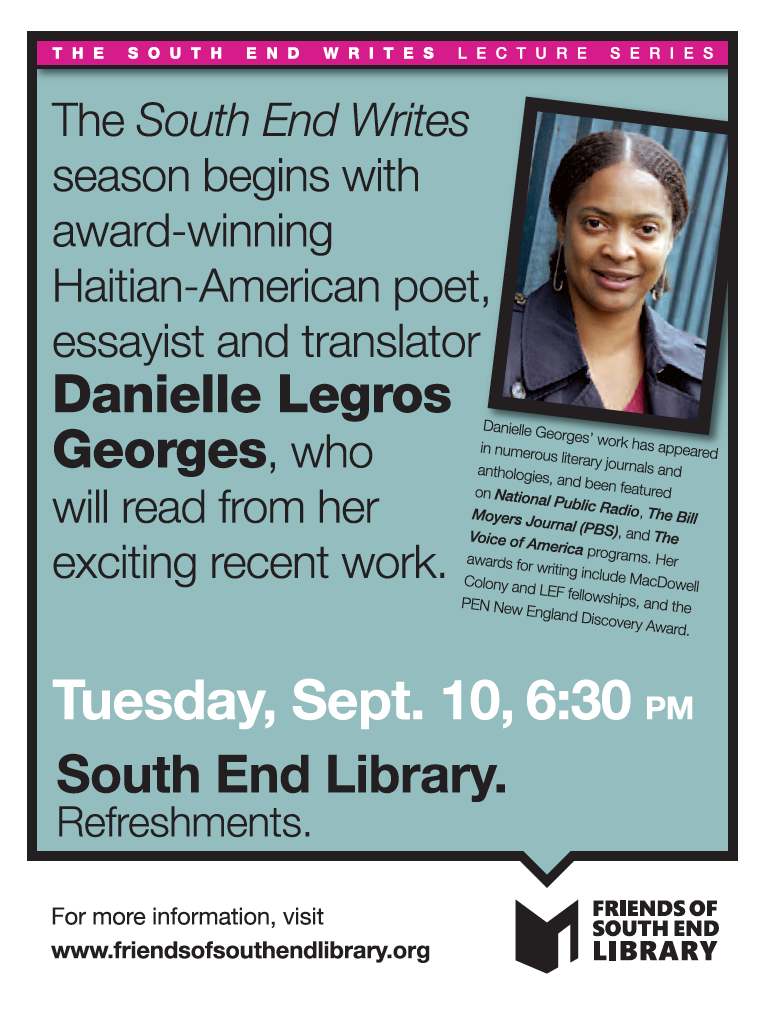
The first South End Writes guest of the season, Danielle Legros Georges, found a small but attentive audience that, by the time the reading was over, had become mesmerized by the poet's performance. Novelist Sue Miller, who introduced the Haitian-born writer she first met while serving with her on the Pen New England board, characterized the poet's 2001 book, Maroon, as one "it was necessary to have," the poems giving her "more pleasure each time I read them." Miller described Legros Georges's poems as deeply varied in both tone and subject, ranging from the ironic to the elegiac to the openly political; from the diaspora of the immigrant experience to the simple act of showering with a lover. Legros Georges read from Maroon, as well as newer work, including poetry by the 19th-century Haitian poet, Ida Faubert. Legros Georges, who is also an essayist and translator, read these first in French, then in English. Faubert was a daughter of a colonial Haitian president in the late 19th century, and is considered a major author in Haiti's literary cannon. She received the prestigious Chevalier de l'Ordre Honneur et Merite from the French government in 1956.

DLG
A powerful rendition of a poem Legros Georges composed about the catastrophic 2010 earthquake in Haiti, Intersection, consisted of one phrase, read some dozen times at varied intensity, with the poet's hands slowly rising. The phrase was, The earth shook; a portal opened; I walked though it. For those few minutes, the audience walked through the portal with Legros Georges, known for her dynamic performances, into the ash and earth.
The South End Writeshas booked another poet, Colin D. Halloran, who served with the U.S. Army in Afghanistan in 2006. A former public school teacher, Colin works with students and teachers to find ways in which poetry can inform the media’s and historians’ portrayals of war. His debut collection of poems, Shortly Thereafter, won the 2012 Main Street Rag Poetry Book Award. His reading is scheduled for Tuesday, April 8, 2014.
Phil Gambone's June 18 Talk Tracing His Father's WWII Route Concluded the 2012-2013 SE Writes; New Season to Resume September 10 with Poet Danielle LeGros Georges

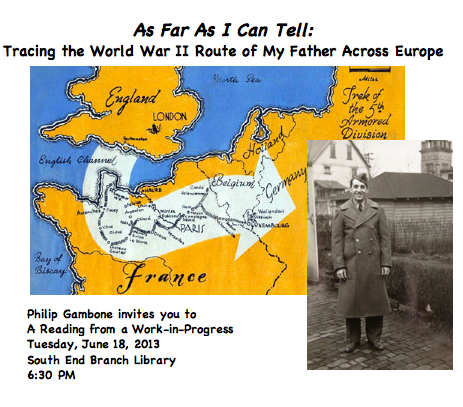
Among the bric-a-brac left by author Phil Gambone's father, a soldier in the Fifth Armored Victory Division that landed in Normandy in July 1944, were a handful of souvenir maps of the route the soldiers took when they fought themselves across occupied Europe, from Utah Beach to Berlin. But when they actually did the fighting and dying, they didn't know where they were. It was a closely held secret until they received the souvenir maps when the war was over in May 1945. War secrets ended, but silence about the war took its place. The father was unable to speak of what he experienced during that war; the son acquired silences of his own, as a gay man, and a student at Harvard during the 1960s who was opposed to the Vietnam War. Unfolding the story embedded in his father's war mementos and the unfinished business of who father and son were as men became the subject of Gambone's latest book-in-progress, As Far As I Can Tell: Retracing my Father's WWII Route Across Europe.
Phil Gambone -2-
As the last author of the 2012-2013 South End Writes series, Gambone described his father as a man of few words, even before the war. He was too shy to ask the vivacious young woman who became Gambone's mother to marry him: she had to ask (and he immediately accepted). While other GIs sent copious mail home, Gambone's dad left a paltry record of six greeting cards. Gambone since discovered that the reluctance to talk about the war is universal among veterans, even those who fought the so-called good war that brought victory. "There seemed to be no way to connect the carnage they had seen with the civil life they lived afterward," Gambone told the spell-bound audience at the South End Library in June. "Your father said the war was horrible," his mother told him. But in retracing the route of the Fifth Armored in Europe during several trips in the last few years, Gambone said his father revealed himself as a man of courage and stamina, and the author began to berate himself for the lack of attention he had paid paid to his dad.
They would meet regularly at The Wursthaus in Cambridge for lunch, but Gambone said he felt they didn't have a lot in common. "The lunches were uncomfortable, stiff," he said. "I wish now we'd talked more but then our conversations were perfunctory." The quest to understand his father became one about finding himself and discovering his own values. He reminded himself that despite the vast destruction that played out in Europe during the Second World War, the same continent was also known for what it had built in previous centuries: transportation networks, exquisite buildings, museums, cathedrals, bridges. Following in his father's steps, he also had to acknowledge what it was that he himself valued, what he one day might want to fight for, thereby, as he put it, " unlocking the silence of each of the men we came to be."
=============

Poet Danielle Legros Georges
The next SOUTH END WRITES series will resume Tuesday, September 10, with a reading by Haitian-American poet Danielle Legros Georges. The essayist and translator is the author of a book of poems, Maroon (Curbstone Press, 2001). Her work has appeared
in numerous literary journals and anthologies, and been featured on National Public Radio, The Bill Moyers Journal (PBS), and The Voice of America programs. Her awards for writing include MacDowell Colony and LEF fellowships, and the PEN New England Discovery Award. She is a visiting faculty member of the William Joiner Center, University of Massachusetts Boston, and leads the Greater Brockton Society for Poetry and the Arts Poetry Workshop.
FOSEL HAS ALSO BOOKED THE FOLLOWING AUTHORS:
Tuesday, October 1: George Cuddy, who wrote the e-book Where Hash Rules, about Charlie's Sandwich Shoppe on Columbus Avenue, famous for many reasons, most recently the visit by President Barack Obama who ordered a cheeseburger with lettuce, tomato, mustard and fries to go, while in town for a fundraiser.
Tuesday, October 22: bestselling thriller writer Joe Finder, author of among other books Paranoia, Company Men, Killer Instinct and Power Play. The movie version of Paranoia is scheduled for release in a theater near you in August. It is directed by Robert Luketic and stars Liam Hemsworth, Gary Oldman, Harrison Ford, Lucas Till, Amber Heard, Embeth Davidtz, Julian McMahon, Josh Holloway and Richard Dreyfuss.
Wednesday, November 13: Megan Marshall, author of the award-winning The Peabody Sisters, will read from her most recent biography, the widely praised Margaret Fuller: a New American Life. Those of you who attended the dynamic SEWrites reading by April Bernard(Miss Fuller) in February may recall her admiring comments about the upcoming Fuller biography by Marshall.
Tuesday, December 3: J. Courtney Sullivan, bestselling author and former New York Times writer whose novels include Commencement,Maine -- winner of the Best Book of the Year by Time magazine-- and, most recently, The Engagegements.
Tuesday, January 14, 2014: South Ender Christopher Castellani, whose recent novel All This Talk of Love got a great review in the New York Times Book Review earlier this year. Previous work includes A Kiss from Maddalena, winner of the 2004 Massachusetts Book Award, and The Saint of Lost Things, a BookkSense Notable Award. Castellani is the artistic director of Boston's creative-writing center Grub Street.
Tuesday, February 25: novelist, short-story writer, editor and teacher of creative writing, Michael Lowenthal will read fromhis most recent The Paternity Test, which describes the voyage of a gay couple trying to save a marriage by having a baby. His previous work includes Charity Girl and The Same Embrace. During Lowenthal's valedictorian speech at Dartmouth College in 1990, he revealed he was gay, prompting The Dartmouth Review to editorialize that he had 'ruined the ceremony.' The New York Times reported he received a standing ovation, however, so all was not lost.
Filmmaker Alice Stone Returns to "The South End Writes" With an Update on Her Documentary, "Angelo Unwritten" Tuesday June 11 at 6:30 PM

South End filmmaker Alice Stone will present what may be the final installment of her feature-length documentary, "Angelo Unwritten," on Tuesday, June 11 at 6:30 PM at the South End Library. Examining the complicated path of a Latino youngster, Angelo, who is placed in foster care with a Caucasian couple at age 12 , the film puts a compelling spotlight on what goes into the making of a family in the context of foster care. The focus has been on his biological family who couldn't care for him, the social workers who defended Angelo's interests as they saw it, and the fiercely loyal foster parents who often groped in the dark for the right answers on how to raise Angelo. In that, most parents viewing the movie will find kinship with those who loved, cared for and were exasperated by Angelo.
Stone's 2012 video clips told the tale of of Angelo having been removed from his foster home at age 17, after the teen had started getting into trouble. The foster parents asked for a routine five-day respite, but it turned into a seven-month separation, against their wishes. Angelo since rejoined his foster parents but, at age 18, is no longer technically in their custody. Nevertheless, they are trying to become a family again. The documentary will follow the family as Angelo makes his way toward high school graduation this year. A Boston Globe's reviewer of last year's video clip of Angelo Unwritten described it as "a not uncommon tale of a child adopted out of foster care who runs into a host of difficulties growing up. The film so far is crisply edited and deeply felt, but this is just a nine-minute snippet of what looks like an epic tale that will no doubt be challenging to put together." Filmmaker Stone recently raised funds through Kickstart for this documentary.

Alice and Angelo
Alice Stone graduated from Harvard College and made the 1994 short film about women motorcyclists, She Lives to Ride. She created a reality television series, Ding Dong Feng Shui, and has written and directed four comedy shorts, two of which continue to screen at the Coolidge Corner Theater in Brookline, MA. The author of four screenplays, Stone co-wrote and edited the documentary feature, Goodbye Baby (New Day Films), about international adoption from the Guatemalan perspective, and edited the feature, No Turning Back, about a human rights activist. She began her career editing political music videos for Peter Gabriel, Jackson Browne and others, and was an assistant editor on The Silence of the Lambs and The Crucible, among other projects.
The next and final reading of the 2012/2013 South End Writes season is Tuesday, June 18, 6:30 p.m. when Philip Gambone, the South End author of Travels in a Gay Nation; Beijng: a Novel; and The Language We Use Up Here, will present his most recent work-in-progress, As Far As I Can Tell: Tracing the World War II Route of My Father Across Europe. Gambone has just returned from his third trip to Europe shadowing the footsteps of his father who never spoke about his war experience.
South End Writes Speakers Dennis Lehane (5/14) and Alice Hoffman (5/21) Say Having Access to Public Libraries as Children Was Critical to Their Development as Writers

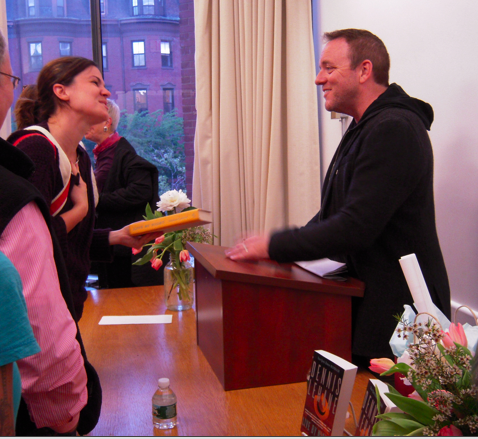
In closely timed appearances at the South End Library this month, two very different but equally successful Boston-based authors singled out community libraries as institutions that gave them the unique chance to find themselves as readers, thinkers and writers."I'm here because of the library," was the unequivocal statement Dennis Lehanemade before a standing-room only crowd in mid-May. "It's like A plus B is C. If you remove B, I wouldn't be here."
Alice Hoffman seconded he motion a week later before another standing-room only crowd at the South End branch when she said, "It gave me a special feeling when I could take out as many books as I wanted from my library in Melbourne on Long Island. That's how I was able to choose other worlds. I was an escapist reader, as I am an escapist writer."
Dennis Lehane and fans at the South End Library
Dennis Lehane choose not to read from his recent novel, Live by Night, but instead talked about what it took to turn himself into a writer. "Ten thousand hours," he said. "That's what it takes to become good." Lehane said he came from a literary family. "They were storytellers," he explained. "We'd visit relatives on weekends, and they'd tell stories. Eight weeks later, they'd tell the same stories, except they'd be different. They had tweaked them." At a local bar where his father would take him for a ginger ale with a straw, storytelling was a blood sport with little tolerance for a slow-moving tale. "Turn the set back on Jimmy," customers would shout when they heard an inauthentic or unfocused account. What would carry the day was the authentic tragedies of the working class he came from, leavened by humor: "I got screwed. But I keyed his car. And I slept with his sister. And told her brother about it." Finally, Lehane said, there was nothing else he could do except make up stories and get people to believe them. "My fear was I’d end up serving beers at Vaughn’s and someone’d say, ‘Hey Hemingway, pour me another Bud.’" Reading urban novels by writers like Richard Price --The Wanderers, Clocker-- changed his life. The characters were a revelation, he said. "I knew those people, what was in their kitchens," Lehane said. "I'd found my subject."

"Many authors talk about themselves but I like to escape from my life," commented Alice Hoffman when describing her writing life a week later. She added she realizes "increasingly how autobiographical my work actually is." By way of explaining both the escape attempt and the discovery her work may be about her life after all, Hoffman took as an example an earlier novel, The Ice Queen. "It's about a girl struck by lightning who survived it. I may have been writing about myself, as a survivor, of cancer. But I removed myself from the circumstances of it,” she said. "Often the writer is the last to know what the book is about.”

Alice Hoffman signing books at the library
The genus of The Dovekeepers was hearing from a guide while visiting her son, an archeologist working in Israel, that there might have been women survivors from the siege in Massada.“That’s when I knew I had a novel,” she said. “These were my themes: love, loss, survival, and women in war who need to protect their children." Visiting Massada in the summer when it was 105 degrees and no one else was there, she found the experience "so mystical, it was as if I could almost hear the women,” she said. A nearby museum with many artifacts from those times further brought the people who lived there to life.“There’s a lack of women’s voices in history,” Hoffman observed: in The Dovekeepers the four female narrators describe their lives at Massada, and the intertwining arts of magic, herbs, medicine, and even witchcraft which, though outlawed, was the territory of women. It took Hoffman five years to write this book. “Had I known how much research I’d needed to do for The Dovekeepers, I never would have done it,” she said. She found a mentor in Richard Elliott Friedman, a biblical scholar at the University of Georgia who happened to be a visiting scholar at Brandeis where Hoffman teaches. “It was a huge gift to have a mentor. It changed my life and my career,” she said. “Whenever I had a question, he’d say, ‘don’t worry, I’ll call my rabbi.’”
Hoffman's next book is a “really little non-fiction book,” she said, which talks about ten things to do when you’re diagnosed with breast cancer. The author helped found the Hoffman Breast Center at Mount Auburn Hospital. The five favorite books of Dennis Lehane and Alice Hoffman can be found under The South End Reads tab.
Never Mind the Global Perspective: Locals Flock to the South End Branch Library to Listen to Authors Who Write About Their Town

Barbara Shapiro Signing Books
When the day begins with the New York Times, the Boston Globe and the South End News, invariably I go for the neighborhood paper first. I am not alone in my skewed judgment: local wins. At the South End Library's most recent readings, local won again when, small and large, but always enthusiastic audiences listened intently to two authors talking about their very different books, both playing in Boston. April 23 saw Joe Gallo present a slideshow about his outstanding illustrated guide to local public sculptures and reliefs, Boston Bronze and Stone Speak to Us; a week later, South End author Barbara Shapiro talked to a standing-room only audience about her 2012 suspense thriller The Art Forger, set in Boston and based on the theft of half a billion dollars worth of art from the Isabella Stewart Gardner Museum in 1990.
Joe Gallo, Next to the Women's Memorial Pedestal
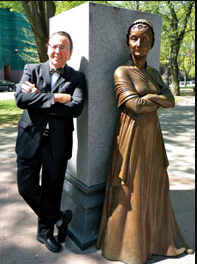
Joe Gallo researched, wrote and published his book after walking through the city made him curious about its public art. He'd had a successful career as an educator and entrepreneur and wanted "to give back to the public." The self-published Boston Bronze and Stone Speak to Us is an excellent guide to the city's sculptures and statues, with beautiful photographs, informative maps showing numbered stars linking sculptures to page numbers for easy exploration. The impassioned author likes to point out that the three women depicted in the Boston Women's Memorial on Commonwealth Avenue --Lucy Stone, Abigail Adams and Phyllis Wheatley-- lean on and stand against their pedestals but none stand ON them...Gallo hopes to publish another edition of his book, in which he hopes to include at least some of the many works of public art he could not put in the current version.
Barbara Shapiro's sixth novel, The Art Forger, was picked up by a publisher other than herself, "after 26 years in the trenches," as she put it. Standing in front of a spellbound audience, she debunked Virginia Woolf's belief that women need "a room of their own" to write in: "All I needed was a working husband with benefits," she said. She is now returning the favor to him, she added. While she was at it, she sent another notion sailing, too, namely "to only write what you know." "After my 11th novel I ran out of things I knew. I wanted to write what I could learn about, " she told the amused audience. Thus, she immersed herself in the life of "Belle," as she came to call Isabelle Stewart Gardner, and the mind-numbing theft of 13 works of her collected art, none of which found, none of which insured (could there be a connection?). Moving to the South End eight years ago where she became involved with the local art community, plus an accidental Google link to the words "art forgery," finally allowed Shapiro to combine the four story strands that had been playing in her head. She wrote an enthralling tale of wealthy Bostonians, struggling artists, the art forgery world and art theft, all set in our town. Her next novel is in an editor's hands so..stay tuned. Shapiro's five favorite books are listed under the South End Reads tab on this web site.
NEXT SOUTH END WRITES READINGS:
Tuesday, May 14, 6:30 p.m.
The spectacularly successful author who grew up in Dorchester and is ALSO one of the nine BPL trustees, last week won the 2013 Edgar Award for his latest novel, Live by Night. Set in Boston in the 1920s, the New York Times’ reviewer called the book a “sentence-by-sentence pleasure.” The Edgars are named for the poet Edgar Allen Poe, and given to the best writers of mystery fiction, non-fiction and television. Previous novels include, among others, Gone Baby Gone, Shutter Island and Mystic River --all made into fabulous movies-- and The Given Day.
Tuesday, May 21, 6:30 p.m.
Alice Hoffman has published a total of twenty-one novels, three books of short fiction, and eight books for children and young adults. Her novel, Here on Earth, an Oprah Book Club choice, was a modern reworking of some of the themes of Emily Bronte’s masterpiece Wuthering Heights. Hoffman’s work has been published in more than twenty translations and some one hundred foreign editions. Her novels have received mention as notable books of the year by The New York Times, Entertainment Weekly, The Los Angeles Times, Library Journal, and People Magazine. The distinguished author wrote the original screenplay “Independence Day,” a film starring Kathleen Quinlan and Diane Wiest. Her teen novel. Aquamarine, was made into a film starring Emma Roberts. Her short fiction and non-fiction have appeared in The New York Times, The Boston Globe Magazine, Kenyon Review, The Los Angeles Times, Architectural Digest, Harvard Review, Ploughshares and other magazines. Her latest, The Dovekeepers, a historical novel describing the AD70 massacre at Masada from the point of view of four women at the fortress before it fell during the Jewish-Roman war, is the most recent of the nearly two dozen novels by Hoffman and just came out in paperback. She will be introduced at this talk by another distinguished writer, Sue Miller.
Tuesday, June 11, 6:30 p.m.
the local filmmaker whose mesmerizing documentary, Angelo Unwritten, has followed the life of a teenager adopted out of foster care when he was twelve, will return with an update of new material gathered since December 2011.
Tuesday, June 18, 6:30 p.m.
will return to read from his current work-in-progress, retracing the steps of his father who, as a soldier, was sent to Europe during the Second World War.
After a Sad Week in Boston, FOSEL Resumes its Author Series Tuesday, April 30, with Barbara Shapiro (The Art Forger), Followed by Dennis Lehane (Live by Night), May 14 and Other Speakers

Barbara Shapiro
Nothing will be as it was before April 15's disastrous events, although it may seem that way: The gardens in front of the library are in bloom as they were last year; so are the trees in Library Park. The Hubway bikes have been reinstalled at the corner of West Newton Street and the trash bins on the block still overflow from time to time, just as always.
FOSEL is preparing for next Tuesday's reading and is looking for a date to have Doug Bauer return, the author who was scheduled to read on April 16 from What Happens Next?: Matters of Life and Death. It is a title that could not have been more appropriate for the occasion. But we needed to pause.
We resume the The South End Writes series on Tuesday, April 30 with a reading by Barbara Shapiro from her suspense novel, The Art Forger. She will be followed on May 14 by Dennis Lehane (Live by Night) and Alice Hoffman (The Dovekeepers) on May 21. Shapiro, a South End resident, based her book on the theft twenty-five years ago at the Isabella Stewart Gardner Museum when it (and the world) was robbed of thirteen works of art. They included four by Rembrandt: Storm on the Sea of Galilee (1633), a Lady and Gentleman in Black (1633), a self portrait (1634), and an etching on paper; Vermeer’sThe Concert (1658–1660); Govaert Flinck’s Landscape with an Obelisk (1638); an ancient Chinese vase; five works on paper by Edgar Degas; a finial from the top of a pole support for a Napoleonic silk flag; and Manet’s painting, Chez Tortoni (1878–1880).
Shapiro is intimately familiar with these works, and virtually every other aspect of this unsolved art heist, as a result of the research she did to transform the givens of the case into the literary thriller that was published last year. She wrote five previous suspense novels, including The Safe Room, Blind Spot, See No Evil, Blameless and Shattered Echoes, and four screenplays, Blind Spot, The Lost Coven, Borderline and Shattered Echoes. She teaches Creative Writing at Northeastern University. The author will be introduced by local filmmaker Alice Stone, who is scheduled to talk about her work-in-progress, the documentary, Angelo Unwritten, on June 11.
Tuesday's event starts at 6:30 PM. Books will be available for borrowing and sale at the reading. Shapiro's five favorite books are listed under The South End Reads, with the selections of this season's previous authors.
Next readings:
Tuesday, May 14, 6:30 p.m.
the spectacularly successful author who grew up in Dorchester and is ALSO a BPL trustee, published his latest novel, Live by Night, in 2012. Set in Boston in the 1920s, the New York Times’ reviewer called the book a “sentence-by-sentence pleasure.” Previous novels include, among others, Gone Baby Gone,Shutter Islandand Mystic River, all made into fabulous movies.
Tuesday, May 21, 6:30 p.m.
The Dovekeepers, a historical novel describing the AD70 massacre at Masada from the point of view of four women at the fortress before it fell during the Jewish-Roman war, is the most recent of the nearly two dozen novels by Hoffman and just came out in paperback. To be introduced by Sue Miller.
Tuesday, June 11, 6:30 p.m.
the local filmmaker whose mesmerizing documentary, Angelo Unwritten, has followed the life of a teenager adopted out of foster care when he was twelve, will return with an update of new material gathered since December 2011.
Tuesday, June 18, 6:30 p.m.
will return to read from his current work-in-progress, retracing the steps of his father who, as a soldier, was sent to Europe during the Second World War.
Tonight's Reading at the South End Library by Doug Bauer ("What Happens Next?: Matters of Life and Death") Has Been Cancelled Due to the Boston Marathon Bombings

Doug Bauer poster
Due to the bombings at yesterday's Boston Marathon, FOSEL's board and author Doug Bauer have cancelled tonight's scheduled reading from What Happens Next?: Matters of Life and Death.The board members extend their condolences to the loved ones of the victims and their empathy and sympathy to the many injured survivors, their families and their friends.
We treasure the vitality of this city, as do all our supporters. We will do all we can to restore and repair it with the passion we have for safe public spaces, civic life, books and films that help us understand the lives we live, art that makes us see the world better, and music to console and revive us. We thank the South End library staff in helping us accomplish these goals.
The next scheduled authors in The South End Writes series are:
Tuesday, April 30, 6:30 p.m.
wrote The Art Forger as a fictionalized suspense thriller based on the heartbreaking heist of 13 irreplacable paintings from the Isabella Stewart Gardner Museum in 1990. The author of five other suspense novels, and the non-fiction The Big Squeeze, the South End resident teaches creative writing at Northeastern University.
=====
Tuesday, May 14, 6:30 p.m.
the spectacularly successful author who grew up in Dorchester and is ALSO a BPL trustee, published his latest novel, Live by Night, in 2012. Set in Boston in the 1920s, the New York Times’ reviewer called the book a “sentence-by-sentence pleasure.” Previous novels include, among others, Gone Baby Gone,Shutter Islandand Mystic River, all made into fabulous movies.
=====
Tuesday, May 21, 6:30 p.m.
The Dovekeepers, a historical novel describing the AD70 massacre at Masada from the point of view of four women at the fortress before it fell during the Jewish-Roman war, is the most recent of the nearly two dozen novels by Hoffman and just came out in paperback. To be introduced by Sue Miller.
=====
Tuesday, June 11, 6:30 p.m.
the local filmmaker whose mesmerizing documentary, Angelo Unwritten, has followed the life of a teenager adopted out of foster care when he was twelve, will return with an update of new material gathered since December 2011.
=====
Tuesday, June 18, 6:30 p.m.
will return to read from his current work-in-progress, retracing the steps of his father who, as a soldier, was sent to Europe during the Second World War.
=====
South End Author Mari Passananti Returns to the South End Library to Read from her New Suspense Thriller, "The K Street Affair," Tuesday, March 19, 6:30 PM
![]Mari Passananti poster](http://static1.squarespace.com/static/58b8b7d8893fc0ddb1aad68a/58b8cd639c03e0fd296714ef/58b8cd7a9c03e0fd29671b8e/1488506234941/Mari-Passananti-poster.png?format=original)
]Mari Passananti poster
Mari Passananti once took her father's advice and went to law school instead of journalism school. She practiced law for a while, became a legal headhunter, but finally quit to write. Her first novel, The Hazards of Hunting While Heartbroken, was published in 2011; her second, The K Street Affair, just came out this year. Her background as an attorney and legal headhunter came in handy for this suspense thriller, since it plays out in our nation's capital and involves the FBI, Saudi and Russian oil interests and a roster of high-profile legal clients. She will read from her latest on Tuesday, March 19, at 6:30 PM at the South End branch.
Passananti is currently working on her third novel. Her books will be for sale and for borrowing at the South End Library. The event is free.
The next scheduled authors in The South End Writes series are:
=====
Tuesday, April 16, 6:30 p.m.
Editor, writer of numerous books of fiction and non-fiction, and revered professor of Literature at Bennington College (to where he commutes from the South End), Bauer will read from his most recent collection of essays, What Happens Next?: Matters of Life and Death. It willbe published in the fall of 2013 by the University of Iowa Press. His previous work includes three novels --Dexterity, followed by The Very Air, and The Book of Famous Iowans, both New York Times Notable Books; and two non-fiction books, Prairie City, Iowa and The Stuff of Fiction. He has edited anthologies, such as Prime Times: Writers on their favorite television shows; and Death by Pad Thai and Other Unforgettable Meals. He has received grants in fiction and creative non-fiction from the National Endowment for the Arts.
=====
Tuesday, April 30, 6:30 p.m.
wrote The Art Forger as a fictionalized suspense thriller based on the heartbreaking heist of 13 irreplacable paintings from the Isabella Stewart Gardner Museum in 1990. The author of five other suspense novels, and the non-fiction The Big Squeeze, the South End resident teaches creative writing at Northeastern University.
=====
Tuesday, May 14, 6:30 p.m.
the spectacularly successful author who grew up in Dorchester and is ALSO a BPL trustee, published his latest novel, Live by Night, in 2012. Set in Boston in the 1920s, the New York Times’ reviewer called the book a “sentence-by-sentence pleasure.” Previous novels include, among others, Gone Baby Gone,Shutter Islandand Mystic River, all made into fabulous movies.
=====
Tuesday, May 21, 6:30 p.m.
The Dovekeepers, a historical novel describing the AD70 massacre at Masada from the point of view of four women at the fortress before it fell during the Jewish-Roman war, is the most recent of the nearly two dozen novels by Hoffman and just came out in paperback. To be introduced by Sue Miller.
=====
Tuesday, June 11, 6:30 p.m.
the local filmmaker whose mesmerizing documentary, Angelo Unwritten, has followed the life of a teenager adopted out of foster care when he was twelve, will return with an update of new material gathered since December 2011.
=====
Tuesday, June 18, 6:30 p.m.
will return to read from his current work-in-progress, retracing the steps of his father who, as a soldier, was sent to Europe during the Second World War.
=====
.
Andre Dubus III, Author of "Townie," Describes the Bones of his Memoir as "I Know What Happened, But What the Hell Happened?"

Standing before a tightly packed audience upstairs at the South End Library, novelist Andre Dubus III talked about the genesis of Townie, and the pitfalls of writing memoirs in general.Townie was an "accidental memoir," he told the mesmerized listeners. He had written several novels (House of Sand and Fog, The Garden of Last Days, Bluesman), but started on what became Townie as an exploration of why he never learned to play baseball the way his sons had. Watching their coaches yell things at them like "Bobby, I want nothing but strikes outta you, you hear that, nothing but strikes," Dubus III always assumed he never got into baseball because it was "too competitive" and therefore just "didn't give a damn." Four years and five hundred pages later he had produced a heart-rending memoir detailing his family's life after his "charismatic father," one of America's best short-story writers, Andre Dubus, "dumped" his mother, a former Louisiana beauty pagaent winner. She was 27, uneducated, with four young children and no income. She found a job and went back to school but her social-work career left the fridge bare and the rent often unpaid.
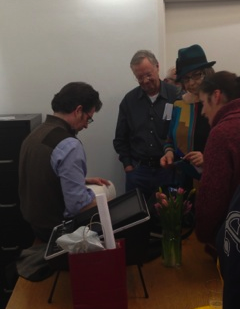
Andre Dubus III signing books
Author Doug Bauer, who introduced Dubus III, said Townie's "raw prose" told two tales: of growing up amid the economic despair of the mill towns of the Merrimack River valley with a mother "long on love and short on cash," and of Dubus III 's "generous acceptance" of his father as a man for whom writing was "essential." Dubus III, now reconciled and resolved about who his father was, told the audience he finds he has to defend him to reviewers and readers. A priest who had once been a stockbroker, asked him if his father, who wrote so "insightfully," had been "a fraud." "All I could say," Dubus III commented, "was that the writer was larger than the man. He was gifted, but AWOL as a father." He worried that perhaps he had not "nailed" his father in his memoir but realized one of the pitfalls of memoir-writing is that it is your truth at a particular moment in time, not someone else's. "It is easy to confuse the writer with the man," he told the crowd. "But I couldn't idealize him. My father was a deeply flawed man who, as a writer, illuminated the truth."
Dubus III's new novel, "Dirty Love," will appear in October. The author has promised to return to the South End Library for a repeat performance. His five favorite books are listed under The South End Reads.
The next South End Writes reading will be on Tuesday, March 19, when South End writer Mari Passananti will talk about her latest suspense thriller, The K Street Affair.
Tuesday, March 19, 6:30 p.m.
will read from her second novel, The K Street Affair.
Tuesday, April 16, 6:30 p.m.
Editor, writer of numerous books of fiction and non-fiction, and revered professor of English at Bennington College (to where he commutes from the South End), Bauer will read from his most recent collection of essays, What Happens Next?: Matters of Life and Death, to be published in the fall of 2013 by the University of Iowa Press. His previous work includes several novels, including Dexterity, The Very Air, and The Book of Famous Iowans; and two non-fiction books, Prairie City, Iowa and The Stuff of Fiction. He has edited anthologies, such as Prime Times: Writers on their favorite television shows; and Death by Pad Thai and Other Unforgettable Meals.
Tuesday, April 30, 6:30 p.m.
wrote The Art Forger as a fictionalized suspense thriller based on the heartbreaking heist of 13 irreplacable paintings from the Isabella Stewart Gardner Museum in 1990. The author of five other suspense novels, and the non-fiction The Big Squeeze, the South End resident teaches creative writing at Northeastern University.
Tuesday, May 14, 6:30 p.m.
the spectacularly successful author who grew up in Dorchester and is ALSO a BPL trustee, published his latest novel, Live by Night, in 2012. Set in Boston in the 1920s, the New York Times’ reviewer called the book a “sentence-by-sentence pleasure.” Previous novels include, among others, Gone Baby Gone,Shutter Islandand Mystic River, all made into fabulous movies.
Tuesday, May 21, 6:30 p.m.
The Dovekeepers, a historical novel describing the AD70 massacre at Masada from the point of view of four women at the fortress before it fell during the Jewish-Roman war, is the most recent of the nearly two dozen novels by Hoffman and just came out in paperback. To be introduced by Sue Miller.
Tuesday, June 11, 6:30 p.m.
the local filmmaker whose mesmerizing documentary, Angelo Unwritten, has followed the life of a teenager adopted out of foster care when he was twelve, will return with an update of new material gathered since December 2011.
Tuesday, June 18, 6:30 p.m.
will return to read from his current work-in-progress, retracing the steps of his father who, as a soldier, was sent to Europe during the Second World War.

Local History and Dynamic Poetry Draw Big Crowds for Lynne Potts (A Block in Time) and Poet April Bernard (Miss Fuller, and New Poems)

It's a good thing that the South End Library offers elevator access to its second-floor community room: It allowed a harried-looking mother with three young children and a squeaky-wheeled stroller to come up and listen to a reading underway by poet April Bernard on a recent Tuesday night. "It made my day," the grateful mother said afterwards.
She was not alone. A large crowd had taken every seat in the room, spellbound first by Bernard's forceful reading from her 2012 fictionalized history of Boston-based feminist Margaret Fuller, followed by five new poems received with appreciative laughter and applause. A week earlier, a standing-room audience listened intently to Lynne Potts describe her 35 years living on Holyoke Street and the research she has done to tie the colorful fortunes of that single block to the larger tale of the South End's many cycles of rise and decline.
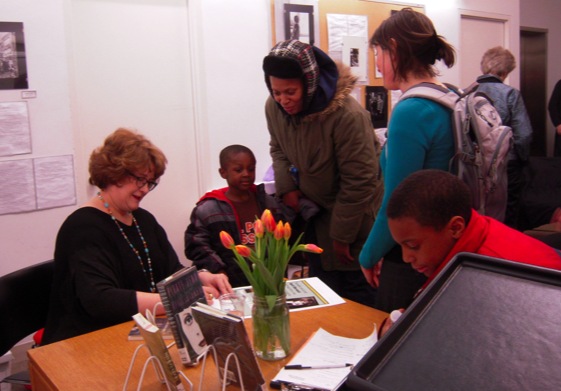
Poet April Bernard signing books
While "Miss Fuller" is fictionalized history, it is based on years of research and "coincides with facts as known," said Bernard, who teaches creative writing at Skidmore College. The story of how Henry Thoreau traveled to the shores of Long Island hoping to find a manuscript that might have survived the shipwreck in which Fuller drowned with her husband and young son in 1850, "planted a seed in my tooth" when she first heard of it, said Bernard. "What if he found something else?" That conceit is at the root of the novel's fiction, and allowed Bernard to weave a new and complex picture of Fuller's character and beliefs, set in tumultuous times when the changes she advocated caused great discomfort not just to close friends and others but also to herself. After a few audience questions, Bernard read five new poems, titled, When I was Thirteen I Saw Uncle Vanya; Werner Herzog in the Amazon; Tis Late; Lids; and Thunder-Mountain-Mesa-Valley-Ridge, all likely to be included in Bernard's next collection. Both Lynne Potts's and April Bernard's five favorite books can be found on this web site under the tab The South End Reads.

Local author Lynne Potts signing books
++++++++++++++++
On Tuesday, February 26, acclaimed author Andre Dubus III (House of Sand and Fog, The Garden of Last Days) will read from his riveting memoir, Townie, in which he describes the violence, bullying and loneliness of his childhoodafter his father, short-story writer Andre Dubus, leaves the family. He will be introduced by his colleague, Doug Bauer. The reading starts at 6:30 PM.
Those who missed Lynne Potts's reading have another chance to hear her when she will read from her book on Thursday, February 21 at the South End Historical Society, 532 Massachusetts Ave, at 6:30 PM. Reservations are required: 617 536-4445 or by email at admin@southendhistoricalsociety.org.
Poet April Bernard to Read from "Miss Fuller," a Fictionalized History of Feminist Margaret Fuller, Once "the Most Famous Woman in America," Tuesday, February 5, 6:30 PM at the SE Library

The cover of Miss Fuller shows a stormy sea seen from the coast, ostensibly New York's Fire Island, where, in 1850, Margaret Fuller perished in a shipwreck with her Italian husband and two-year-old son. The tragic dimensions of Fuller's life and death are narrated from the points of view of various characters belonging to the Concord Transcendentalists, who had awaited her return. Henry David Thoreau, traveling to Fire Island hoping to find manuscripts among the soaked debris that washed ashore after the hurricane passed, finds something else instead, which forms the fictionalized framework of Bernard's 2012 work.
April Bernard is a novelist, poet, and essayist whose most recent book of poems is Romanticism (2009). Previous poetry collections are Blackbird Bye Bye, Psalms, and Swan Electric. Her work has appeared in The New York Review of Books, The New Yorker, The New York Times Book Review, The New Republic, The Nation, and Slate. She has taught widely and was for many years a magazine and book editor in New York City. Her honors include a Guggenheim award, the Walt Whitman Award from the Academy of American Poets, a Whitney Humanities Fellowship at Yale University, a Sidney Harman Fellowship, and the Stover Prize. As Director of Creative Writing, she is a member of the English Department faculty at Skidmore College, and is also on the faculty of the Bennington MFA Writing Seminars. Her five favorite novels are listed under The South End Reads tab of the FOSEL web site.
Ms. Bernard will read from Miss Fuller as well as from her poetry collection, Romanticism. Both books will be available for sale, signing and borrowing from the library. The writer will be introduced by author Doug Bauer, also on the faculty of Bennington College, whose next collection of essays --What Happens Next?--will be published this fall.
On February 26, the South End Writes will host nationally known writer Andre Dubus III, who will read from Townie, a Memoir.
Looking Back 45 Years and Longer, Lynne Potts Will Read from her Memoir, "A Block in Time: a History of the South End from a Window on Holyoke Street" Tuesday, January 29, 6:30 PM

Lynne Potts
"Holyoke Street, a single block of row houses in the South End of Boston, was built in the 1860s as housing for upper- and middle-class families," is how Lynne Potts begins the memoir of her time in what is now the largest Victorian neighborhood in the United States. In a carefully documented paperback illustrated with photographs and drawings, the author weaves a history of the beginnings of the South End in the early 1800s, when it was still mostly underwater, to its nascent form as a neighborhood for wealthy Bostonians decades later, and its subsequent decline toward the end of the 19th century. How it reemerged in the 20th and 21st centuries as one of the most sought-after and diverse neighborhoods in Boston is the tale with which she intertwines her own, arriving first in 1968 from New York City as a student and ten years later as a single mother with two young children, Sam and Emmy, to whom the book is dedicated.
Many names of local characters who helped shape the history of the neighborhood can be found in the pages of this delightful book, some still around, others not, including Eleanor Strong, Allan Crite, Ann Hershfang, Marcie Curry and Mel King. The movement to preserve open space in the neighborhood by means of establishing community garden plots, the opening of first Bread and Circus store (now Whole Foods), the creation of Southwest Corridor Park and historic fights to keep the South End branch of the Boston Public Library open are covered as well. In the 1980s, Potts began to write about it all for The South End News, then just founded as a 24-page local newspaper by Alison Barnet and Skip Rosenthal.
Lynne Potts is a poet who currently lives both in the South End and in New York City, where she received an MFA from Columbia University. Her poems have appeared in the Paris Review and other literary journals, and she was the Poetry Editor of the Columbia Journal of Literature and Art. Her five favorite books are listed under The South End Reads on this web site.
Author Leah Hager Cohen Explores the Unique Dimension of Sorrow Experienced by Each of her Characters in her Novel, "The Grief of Others,"

A roomful of people greeted Leah Hager Cohen on January 15 when she read at the South End branch from her latest, and highly acclaimed, novel, The Grief of Others. Introduced by author Doug Bauer, who substituted for Sue Miller, out with a bad cold, Hager Cohen started out by saying that she is happiest when writing but "second happiest' when in a library "with other library people." She read a section from the novel that harkened back to a summer vacation in a family cabin where a couple and three children from two relationships are united for the first time in years, each bringing with them an assortment of wounds and sorrows that are explored underneath the starry skies of the Adirondack mountains, a place where, as Hager Cohen described it, the lake's black water at night "is warmer than the air." This is the first novel where she used physical details from places she knows well, the Adirondacks and the town of Nyack, NY, something she had resisted in her previous work, she told the spellbound audience, until her agent suggested doing otherwise for this novel.

Author Leah Hager Cohen at the South End library
How people grieve is not quantifiable, the author suggested in response to various comments about how contemporary culture deals with sorrows large and small because "we each do it in our own unique way." Her mother taught her "no one lives very long without sorrow or grief," and that, through like experiences, we are all part of a larger community, in our own time --horizontally-- and through time --vertically-- with our ancestors and descendants.
One of Hager Cohen's earlier non-fiction books, Train Go Sorry, offered personal history of a different kind, specifically the experience of her immigrant grandparents, both deaf, and of her father who ran a school for deaf children, told from the author's perspective as a person with hearing. Or, as Doug Bauer put it, as someone who "yearns to be part of that culture, one she grew up so close to, and yet could not fully be a member of."

Author Doug Bauer introduced Hager Cohen
Answering a question from the audience of how she became a writer Hager Cohen said that, when she was little, she would name each of her fingers and tell stories about them, which her mother transcribed. "She gave me the gift of taking seriously what I was doing," Hager Cohen said. Later on, in journalism school, a professor asked whether he could show the non-fiction she had written, about the deaf culture, to his agent, which set her on the road to being a published writer, first in non-fiction, but in fiction shortly after.
Hager Cohen said she is "excited" about the new book she is working on: It is based on the question of how to love, or live with, someone who is hard to love.
Her five favorite books are listed on the FOSEL web site under The South End Reads.
The "South End Writes" Author Series Resumes Tuesday, January 15, with Leah Hager Cohen Reading from her 2012 Novel, "The Grief of Others"

FOSEL president Marleen Nienhuis, author Margot Livesey and novelist Sue Miller
When the Friends of the South End Library (FOSEL) began to sponsor authors at the South End Library to read from their work three years ago, we had no idea how popular the adventure would become, or whether anyone would show up. What we did know was that the South End branch had an incredibly supportive and interested staff who would help us, that the South End is, was, and likely will always be a haven for writers, artists, musicians and other creative minds, and that we had a wonderful graphic designer on our board, Mary Owens, who would generously and cleverly volunteer to do the posters we needed to announce the readings.
It's easy to take for granted all the different roles a free public library plays in the community it serves, from the vaulted place of research to the simple refuge that is cool in the summer, warm in the winter, with a free, clean bathroom in a culture where that sort of basic amenity can be hard to find.
What FOSEL was not fully cognizant of at the time is that a library is also a place where local residents can find out who else actually lives here, who is writing what, who is thinking what, and what our local history is. This is what The South End Writes has become: a mirror of literary achievement by the many fine writers, journalists and poets who live where we live, shop where we shop, take the T and go to the polls just like we do. We just didn't know who they were, but increasingly we do. Writers are invited by FOSEL board members, by FOSEL supporters and literary luminaries like Sue Miller and Doug Bauer, and by the South End Library staff, headed by Anne Smart. The ones who have enriched us with their work include Sue Miller, Doug Bauer, Chris Kimball, Joanne Chang, John Sacco, Phil Gambone, Johnny Diaz, Susan Naimark,, Henri Cole, Sara Lawrence Lightfoot, Stephen Davis, Margot Livesey, Alice Stone, Mari Passananti, Maryanne O'Hara, L. Annette Binder, Edith Pearlman, Christine Chamberlain, Sven Birkerts, Wendy Wunder, Lily King, Susan Conley, Alison Barnet and Scott Pomfret, among others.
Coming up between now and the summer are:Leah Hager Cohen, Lynne Potts, April Bernard, Andre Dubus III, Mari Passananti, Doug Bauer, Dennis Lehane, Alice Hoffman, Alice Stone, and Phil Gambone. Some will read at the South End branch for the first time; others are returning to update us on new work, or work in progress.
Perhaps the best compliment paid to The South End Writes is that another library Friends group, at the Jamaica Plain branch, has begun its own series, Jamaica Plain Writes, with the first author, JP resident Chuck Collins, appearing there on Thursday, January 24, at 6:45 p.m. Collins is an expert on U.S. inequality, the author of several books, and a senior scholar at the Institute for Policy Studies, a progressive think tank. For further information about the JP Writes series, check the link to their web site here.
Below is the list of writers scheduled to appear at the South End Library until July. Occasionally, schedules need to change, but FOSEL posts them on this web site as soon as they become known.
Wishing you a Happy and Writerly New Year....
UPCOMING READINGS FOR THE SOUTH END WRITES ARE:
January 15, 2013, 6:30 p.m.
Leah Hager Cohen
The author, who publishes both fiction and non-fiction, will read from her latest novel which the New York Times described as “her best work yet.” With an introduction by Sue Miller
Tuesday, January 29, 6:30 p.m.
A Block in Time: a History of Boston’s South End from a Window on Holyoke Street. The author, who moved into a house on Holyoke Street with two young children in 1978, has written a personal history that includes what it was like to be young in the 60s, the turmoil and transformations of the South End from the time it was created out of Boston Bay, and captivating details of the characters in her neighborhood. A poet as well as a writer, she splits her time living on Rutland Street and in New York City, where she was Poetry Editor of the Columbia Journal of Literature and Art.
Tuesday, February 5, 6:30 p.m.
The poet (Romanticism)and novelist, most recently of history (Miss Fuller), is currently the director of creative writing at Skidmore College. With an introduction by South End author Doug Bauer, whose own new collection of essays, "What Happens Next?" will come out this fall.
Tuesday, February 26, 6:30 p.m.
Andre Dubus III
The examination of the author’s violent past has been described ”best book” of non-fiction of 2011 and 2012 by many literary-gate guardians, and was preceded by his previous novelsHouse of Sand and Fog (made into a movie by the same name) and The Garden of Last Days. Sue Miller will introduce the author.
Tuesday, March 19, 6:30 p.m.
will read from her second novel, The K Street Affair.
Tuesday, April 16, 6:30 p.m.
Editor, writer of numerous books of fiction and non-fiction, and revered professor of English at Bennington College (to where he commutes from the South End), Bauer will read from his most recent collection of essays, What Happens Next?, to be published in the fall of 2013 by the University of Iowa Press.
Tuesday, May 14, 6:30 p.m.
Dennis Lehane, the spectacularly successful author who grew up in Dorchester and is ALSO a BPL trustee, published his latest novel, Live by Night, in 2012. Set in Boston in the 1920s, the New York Times’ reviewer called the book a “sentence-by-sentence pleasure.”
Tuesday, May 21, 6:30 p.m.
The Dovekeepers, a historical novel describing the AD70 massacre at Masada from the point of view of four women at the fortress before it fell during the Jewish-Roman war, is the most recent of the nearly two dozen novels by Hoffman and just came out in paperback. To be introduced by Sue Miller.
Tuesday, June 11, 6:30 p.m.
the local filmmaker whose mesmerizing documentary, Angelo Unwritten, has followed the life of a teenager adopted out of foster care when he was twelve, will return with an update of new material gathered since December 2011.
Tuesday, June 18, 6:30 p.m.
will return to read from his current work-in-progress, retracing the steps of his father who, as a soldier, was sent to Europe during the Second World War.
The five favorite books recommended by the authors mentioned above, and previous speakers, can be found under THE SOUTH END READS.
Author Marylou Depeiza Will Read from her Suspense Novel, "Walking in her Shoes," the Story of her Mother's Secret Life While Raising a Traditional Family in the South End

Marylou Depeiza
After her mother's death in the mid-1990s, Marylou Depeiza decided to find out what might be the mystery at the center of her mother's life, something she had tried to uncover before but been told to stay away from. Leola Williams, wife of a World War II veteran who was raising a family of six while living in the South End, had a secret life that her daughter discovered doing genealogical research on the Internet. "Walking in her Shoes" is the result. Depeiza will read from the suspenseful novel based on her mother's life at the South End Library, Tuesday, November 27, at 6:30 PM.
Recent Readings by Authors at the South End Library Illustrate the Varied Richess of the Local Writing Scene and the Unique Role Played by Branch Libraries in their Neighborhoods

FOSEL founding president Marleen Nienhuis and novelists Margot Livesey and Sue Miller
The range of authors who came to talk about their work at the South End Library during Halloween season provided a nice illustration of the deep and varied pool of writing talent that exists at the local level, and the supportive role neighborhood libraries play in hosting them. On October 25, Maryanne O’Hara, a short-story writer who lives in the South End, discussed her much-praised first novel, Cascade, which is based on the flooding of a town in Western Massachusetts in the 1930s. She was followed a few days later by acclaimed novelist and Distinguished Writer-in-Residence at Emerson College, Margot Livesey, who talked about her latest work, The Flight of Gemma Harding,a re-imagening of Charlotte Bronte’s Jane Eyre. That same week, rock biographer Stephen Davis, arrived at the South End branch with a seemingly inexhaustible collection of anecdotes and observations about the rock and pop stars he’d written about for decades, after reading from his most recent (unauthorized) biography of Carly Simon, More Room in a Broken Heart.
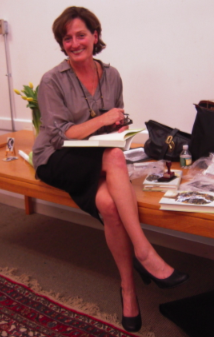
Maryanne o'Hara giving a talk at the South End library
O’Hara’s novel, while a fictionalized account of a to-be-drowned town, attracted an audience interested in the actual flooding of small towns in Massachusetts by the Quabbin reservoir in the 1930s. The author did not disappoint: she brought copies of old photographs of the four towns that became submerged –Dana, Enfield, Greenwich and Prescott– and, after signing copies of her book, even used a stamp with a special postmark of the novel's make-believe town, Cascade, on the last date of its supposed existence, December 27, 1934. Part of the research for the novel was done at the Waterworks Museum on Chestnut Hill, O’Hara said, which documents the history of the country's first metropolitan water systems. O’Hara’ inspiration for the main character, artist Dez who is torn between ambition and family tradition, was sparked by an interview with WPA painter James Lechay in Truro, MA, a decade ago. Her subsequent interest in the WPA, and the 1930s' government support for the arts, turned first into a magazine article, but eventually found its way into her novel, as did O'Hara's love for Shakespeare --a Shakespeare summer theatre features prominently,-- and the author's fascination with the actual drowned towns of the Quabbin reservoir.

Author Stephen Davis
Margot Livesey was introduced by novelist Sue Miller, who said she loved Livesey's novels before she ever met the author, and especially appreciated what she described as the novelist's thoughtfulness for the “mysteriousness of otherness.” Livesey explained that in The Flight of Gemma Hardy she examined why 21st-century female readers of Jane Eyre still identify in such profound ways with the 19th-century character, even though their lives are vastly different. She suggested that the novel, which has not been out of print in 165 years, still speaks to readers for two reasons: the heroine represents the arche-type of orphan and pilgrim, and it explores the fundamental question asked by the Bronte sisters of how a girl of no special talents, without a family or special skills, can make her way in the world. In The Flight of Gemma Hardy she wanted to “re-imagine the appeal of Jane Eyre for those who loved it and those who hadn’t read it.” Having been raised herself in a boys’ private school in Scotland, where her father was headmaster, and her ‘severe’ stepmother’s notion of children was they best be ‘seen but not heard,’ the author recounted she spent much time hoping for a natural disaster that would destroy the school and its Gothic buildings. Nevertheless,the English landscape has been the setting for most of her writings but after living in the US for many years, her current work-in-progress, or as she described it, “the novel I am failing to write,” is set in contemporary New England.
Stephen Davis’s animated talk about the world of pop and rock as he experienced it, writing first for the Boston Phoenix and Rolling Stone magazine and concentrating on rock biographies later, centered on the life of singer/songwriter Carly Simon, who he knew closely through friendships with her brother Peter, and the time their families spent on Martha’s Vineyard growing up. Describing her rise to fame, Davis placed her squarely in the culture of the 60s and 70s, when successful female singers were few and far between but the female audience of baby boomers was ready for their music, even when they didn’t know it until they heard it. “Carly was part of the continuum of how things should be rather than were,” Davis said. “When her Greatest Hits came out, it was what the women in minivans listened to taking their kids to soccer practice.” The talented Simon had romantic relationships with many stars, and “learned from her boyfriends,” said Davis. They included Cat Stevens --a date with him inspired Simon's song Anticipation-- and James Taylor, who was her husband until she “threw him out” when she feared his drug addiction would become an issue for their two children. “She doesn’t have his phone number to this day,” said Davis, even though theirs was a “great romantic love story,” he added. Davis, who ghost-wrote the autobiography of Michael Jackson at the request of Doubleday's then-editor Jacqueline Onassis --"she made the phone calls; someone else edited,” he said,-- is currently working on the biography of Stevie Nicks, the singer/songwriter who sang for many years with Fleetwood Mac.
The five favorite books recommended by the authors mentioned above, and previous speakers, can be found under THE SOUTH END READS.
UPCOMING READINGS FOR THE SOUTH END WRITES ARE:
January 15, 2013, 6:30 p.m.
Leah Hager Cohen
The author, who publishes both fiction and non-fiction, will read from her latest novel which the New York Times described as “her best work yet.” With an introduction by Sue Miller
Tuesday, January 29, 6:30 p.m.
Lynne Potts
A Block in Time: a History of Boston's South End from a Window on Holyoke Street.
Details will be posted as they become available.
Tuesday, February 5, 6:30 p.m.
April Bernard
The poet (Romanticism)and novelist, most recently of history (Miss Fuller), is currently the director of creative writing at Skidmore College. With an introduction by South End author Doug Bauer
Tuesday, February 26, 6:30 p.m.
Andre Dubus III
The examination of the author’s violent past has been described ”best book” of non-fiction of 2011 and 2012 by many literary-gate guardians, and was preceded by his previous novelsHouse of Sand and Fog (made into a movie by the same name) and The Garden of Last Days. Sue Miller will introduce the author.
Tuesday, March 19, 6:30 p.m.
will read from her second novel, The K Street Affair.
Tuesday, April 18, 6:30 p.m.
Editor, writer of numerous books of fiction and non-fiction, and revered professor of English at Bennington College (to where he commutes from the South End), Bauer will read from his most recent collection of essays, What Happens Next?, to be published in the fall of 2013 by the University of Iowa Press.
Tuesday, May 14, 6:30 p.m.
Dennis Lehane, the spectacularly successful author who grew up in Dorchester and is ALSO a BPL trustee, published his latest novel, Live by Night, in 2012. Set in Boston in the 1920s, the New York Times' reviewer called the book a "sentence-by-sentence pleasure."
Tuesday, May 21, 6:30 p.m.
The Dovekeepers, a historical novel describing the AD70 massacre at Masada from the point of view of four women at the fortress before it fell during the Jewish-Roman war, is the most recent of the nearly two dozen novels by Hoffman and just came out in paperback. To be introduced by Sue Miller.
Tuesday, June 11, 6:30 p.m.
the local filmmaker whose mesmerizing documentary, Angelo Unwritten, has followed the life of a teenager adopted out of foster care when he was twelve, will return with an update of new material gathered since December 2011.
Tuesday, June 18, 6:30 p.m.
will return to read from his current work-in-progress, retracing the steps of his father who, as a soldier, was sent to Europe during the Second World War.
Rock'n Roll Biographer Stephen Davis Reads From the Unauthorized Biography of Singer/Songwriter Carly Simon, "More Room in a Broken Heart," at the SE Library, Thursday, November 1, at 6:30 p.m.
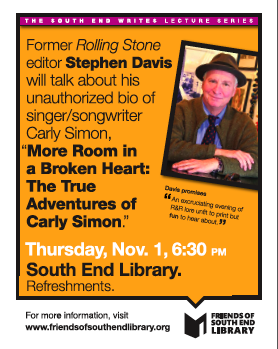
stephen davis
Music journalist Stephen Davis will read from his most recent rock'n roll biography, More Room in a Broken Heart: the True Adventures of Carly Simon, at the South End Library this Thursday, November 1, at 6:30 p.m. It is an unauthorized biography, ostensibly because singer/songwriter Simon feels the book is 'too revealing,' according to Davis, who was interviewed earlier this year on the Emily Rooney show. Controversy also centered on other authors accusing him of using their material in this book. Davis says he'd prefer to recast that criticism as 'copying' of material already published although, he freely acknowledged, without the complete bibliographic attribution by the publisher he had hoped for. "In the paperback, we'll do that," Davis told Rooney.
Davis has a distinguished record of more than a dozen pop and rock biographies, including Hammer of the Gods: the Led Zeppelin Saga (1985), Watch You Bleed: the Saga of Guns 'N Roses (2008), and Bob Marley: Conquering Lion of Reggae (1994). He was the ghostwriter for the autobiography of the late pop star Michael Jackson, Moon Walk, which was edited by Jacqueline Onassis and sold out as soon as it hit the New York Times bestseller list. It was never reprinted or issued in paperback. Davis, whom the Boston Globe described as "the gold standard of rock biographers," began his career at The Boston Phoenix. His articles, written in an engaging and lively prose style, have been featured in Rolling Stone magazine and the New York Times, among other publications.
The author will be introduced by FOSEL board member Courtney Fitzgerald, who invited him to speak at the South End branch. Davis has promised to give the audience "an excruciating evening of R & R lore unfit to print but fun to hear about."
Davis's books will be available for purchase and signatures and, thanks to head librarian Anne Smart, for borrowing, as well.
Margot Livesey Will Read from her Latest Novel, "The Flight of Gemma Harding," Tuesday Night, October 30, at 6:30 P.M.
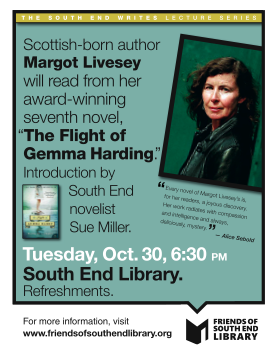
livesey
Scottish-born Margot Livesey, who is currently a distinguished writer in residence at Emerson College, will read from her latest novel, The Flight of Gemma Hardy, this coming Tuesday, October 30, at 6:30 p.m., at the South End Library. She will be introduced by novelist Sue Miller, who invited her to The South End Writes program. Liveley has suggested that a novel, "as its name intimates, brings us news of another kind, and it is news that we vitally need, though it may not make the headlines. For what a novel does is to help us fill the abyss between the self and other." About learning the craft of writing a novel, she has said, "I had spent many happy hours in the house of fiction, but I knew nothing about plumbing or wiring or putting up drywall."
The Flight of Gemma Harding is Livesey's seventh novel and is loosely based on Charlotte Bronte's Jane Eyre. Other novels include Eva Moves the Furniture (2001) and The House on Fortune Street (2008). While writing, she has taught at Boston University, Bowdoin College, Brandeis University, Carnegie Mellon, Cleveland State, Emerson College, the Iowa Writers' Workshop, Tufts University, the University of California at Irvine, the Warren Wilson College MFA program for writers, and Williams College. She has been the recipient of fellowships from the Guggenheim Foundation, the N.E.A., the Massachusetts Artists' Foundation and the Canada Council for the Arts.
Livesey's books will be available at the reading for borrowing, purchasing and signing.
The BPD's Archivist Margaret Sullivan and her Colleague Dr. Kim L. Gaddy Shine a Light on the History of Boston's Fairest

After personnel files were put on microfilm at the Boston Police Department in the 1970s, a sergeant detective about to retire dumped a box of women's roster cards on the desk of another, Kim L. Gaddy, saying she didn't have the heart to shred them. "That's how it all started," Dr. Gaddy told a rapt audience at the South End Library on October 16, during the slide show of "Boston's Fairest." With Margaret Sullivan, the BPD's archives and records manager, Dr. Gaddy spent hundreds of hours at Radcliffe's library and the "dank basement" of the BPL, among other places, to document the history of Boston police women.
They only had to go back to the 1920s. The time between the two world wars was one of social change and the 1919 Boston Police Strike had decimated the department. It consisted of "rookies and old men," said Sullivan. In 1921 the first six women who had been allowed to take the entry exam were appointed. They were denied uniforms, weapons, cars and handcuffs. But they had their badge. They'd show it, presumably bark "you're under arrest," and haul the perps to the police station by hailing a cab. More women were hired in the 1940s, including the first African-Americans, among them Dorothy "Harry" Harrison, the daughter of physician Columbus Harrison, who practiced from his home on Chandler Street. "Can you explain why these women were placed in the South End which was one of the most dangerous parts of Boston?" one member of the audience wanted to know. "Because they were good," said Sullivan, "and they knew the district very well."
The BPD remained largely the domain of men. But the perpetrators included women, as did of course the victims of crime. Handling female prostitutes or battered women caused discomfort among male law enforcement. The female recruits were expected to focus on women by protecting them from "mashers" (men who'd harass them) and bring home lost children. They did that --even bought kids ice cream on the beaches of South Boston-- but would land punches, if necessary, with the best of them.
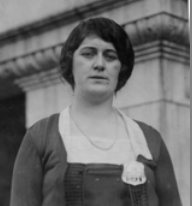
Despite nine decades of proving their worth, the BPD’s percentage of female officers is still only 14 percent, roughly on par with the police departments elsewhere. “Police work has a very macho image but it is 85 percent social work, instead of knocking heads” said Dr. Gaddy, explaining part of the reason why women many not even see police work as suitable for them to this day. Answering another audience question, the speakers affirmed no specific efforts are underway by the BPD to demystify what this profession is all about. "It's hard to get across why police work might appeal to college women" now looking to make career choices, agreed Sullivan. "It's not the only barrier," she said, referring to other disincentives: jobs are not necessarily there right now, you have to be put 'on the list,' you have to live in Boston, there are several tests. "By the time you take care of that, most will have made other choices," she said.

The first African-American female olice officer, Dorothy Harris
A few years ago, Sullivan helped uncover the history of Boston's first African-American officer in the BPD in 1878, Sgt. Horatio J. Homer. She is currently working on the biographies of some twelve police officers (she calls them her "dirty dozen") who made difficult choices in their careers, including resigning when that was 'the right thing' to do. "It's hard to be a good cop sometimes," Sullivan said. One of her subjects is a former resident of Rutland Square, Captain Francis Wilson, whose father, Butler Wilson, a staunch Republican, helped start the Boston branch of the NAACP.
Short-story Writer Maryanne O'Hara Will Read from her Debut Novel, "Cascade," Thursday, October 25 at 6:30 PM
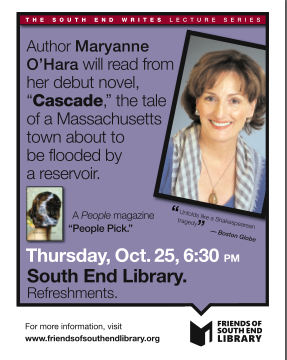
maryanne ohara
Maryanne O'Hara's first novel, Cascade, provides a fictionalized account of the attempted flooding of a small town in Western Massachusetts. Something like this really happened, of course, in the 30s, when the creation of the Quabbin reservoir 65 miles east of our fair city flooded not just one, but four towns: Dana, Enfield, Greenwich and Prescott.
The image of a drowned town once alive with community and history has been an enticing one for storytellers, including South End novelist, Sue Miller, who also used the metaphor in her 2001 novel, The World Below.
O'Hara's Cascade refers not to the flood, but to the actual town in which the main character, Desdemona, is born and raised. When Cascade is jeopardized by the damming of a nearby river, she fights for her own survival as an artist and a wife, as well as the town's. "Gorgeously written," said Caroline Leavitt, who reviewed it this summer for The Boston Globe.
O'Hara's reading on Thursday, October 25, starts at 6:30 p.m. Copies to borrow, buy and sign are available at the event.